
Civic Assembly presents recommendations on city budget process
Two groups of 30 semi-randomly selected Culver City residents worked to create a 93-page report with formal recommendations on increasing public participation in the budget process

Culver City’s Civic Assembly has spoken on the city’s Budget Process.
The results of the city’s first two Civic Assemblies were presented to the city council at its last meeting on August 10. The bodies considered more than 100 aspects of public participation in the city’s budget process over two separate 3-day sessions to recommend improvements to increase public participation in creating the city’s budget.
These Civic Assemblies were two cohorts of 30 semi-randomly selected Culver City residents, each of whom spent three days deliberating about the budget process. In total, participants invested about 1,500 hours of time during these first Assemblies.
The first two sessions of the assembly produced a 93-page report answering a single question: How might the City of Culver City increase public participation in the budget process?
What is a Civic Assembly?
A Civic Assembly is a body of semi-randomly selected individuals who come together with the support and initial leadership of a specialized firm to create formal recommendations to present to government bodies on key issues.
It is a relatively new tool for municipal entities, but has grown in popularity in recent years. Culver City’s Civic Assembly was organized by the Center for New Democratic Processes (CNDP), a firm which specializes in Civic Assemblies and other non-traditional forms of government participation.
CNDP has hosted similar assemblies to provide formal public feedback on issues ranging from nuclear storage in Adelaide, Australia to a Neighborhood Specific Plan in Vancouver, British Columbia.
Other firms have used the civic assembly process to give residents a voice in decisions like the future direction of the Petaluma Fairgrounds in Northern California, how to address youth homelessness in Central Oregon, and the rewriting of the Los Angeles City Charter earlier this year.
How was the Body Created?
The philosophy behind the Assembly is to remove bias and outside influence through random selection, creating a pool of individuals whose demographics reflect the city’s overall makeup. Fliers were sent to a randomly selected group of households, and those who responded with interest were sorted into individual pools crafted to meet demographic thresholds similar to those seen in Culver City.
One of the demographically representative groups is randomly selected to serve as the Civic Assembly. Culver City’s Civic Assembly had two sessions, each with 30 members. Participants described themselves through a variety of terms, showing the wide range of origins, interests, and perspectives among the members of Culver City’s first Civic Assembly Process.
Many shared common threads, like being fond of animals and lovers of great food, but participants came from diverse backgrounds. Fathers and husbands gathered alongside at least one single mother and a self-described “queer” person; assemblymembers communicated interests ranging from tennis to musical theater to video games, and one participant identified themselves as a “speed jigsaw puzzle competitor.”
What did the Civic Assembly Do?
Before participating in the Civic Assembly, most of its members did not have any experience or exposure to the city’s budget or the annual process by which it is created, so the first step was to introduce the government of the City of Culver City, the city’s finances, and the budget process to the Assembly before deliberating on the topic at hand.
Additionally, the assemblies selected community organizations and city staff members to speak about what they do, deepening their understanding of the community and the intricate relationships that sustain its day-to-day operations.
These ranged from city staff like City Manager Odis Jones and Chief Communications Officer Dustin Klemann, who could discuss internal operations, to established and embedded organizations like the Culver City Downtown Business Association and the Culver City Chamber of Commerce, to resident-driven movements like Our Culver and Culver City Neighbors United.
Once participants were more familiar with city operations, the Civic Assemblies worked to develop formal recommendations for the city council to consider. While the first group identified over 100 challenges, opportunities, and other notable points related to public participation in the city’s budget process, the second assembly reviewed and refined the first assembly's work into what was presented in the final report.
What were the Results?
CNDP and several Civic Assembly participants presented the 93-page report detailing the results of the Civic Assembly process to the city council. The core of the report is a set of 20 recommendations: 10 focused on tackling obstacles facing residents trying to engage in the budget process and 10 on opportunities to make the budget process more accessible and essential in the eyes of Culver City’s residents.
Themes that resonated throughout included difficulty understanding how to read the budget and how to provide input once that understanding is achieved. Among the most important improvements were presenting information in a more digestible way through several avenues, such as a simplified budget change summary and a simulation activity that allows users to understand how the Culver City budget works through firsthand experience.
How the city receives feedback from its residents was also among the most prominent concerns agreed upon by the Assemblies. People want their voices to be heard, and community members are concerned that the current process does not instill trust that their participation was meaningful or led to tangible change.
Ensuring a transparent feedback loop that shows “how participation resulted in the nuanced or meaningful change based on the feedback the City received from the process” was among the most urgent points agreed upon by the Civic Assembly participants. One participant commented about the importance of seeing his words on display in the Civic Assembly report, noting that it made him feel like “[his] voice matters.”
“Nothing motivates [people] more than seeing the fruits of their [labor],” one Assembly participant said during the presentation.
However, there is also a feeling that some people simply do not want to participate in the process as long as the services provided by the city are to their satisfaction. The two challenges seen by the largest percentage of assembly participants as most pressing are that people don’t see participation as a priority and that residents do not realize their lack of participation in the process may lead to negative consequences until after it is over.
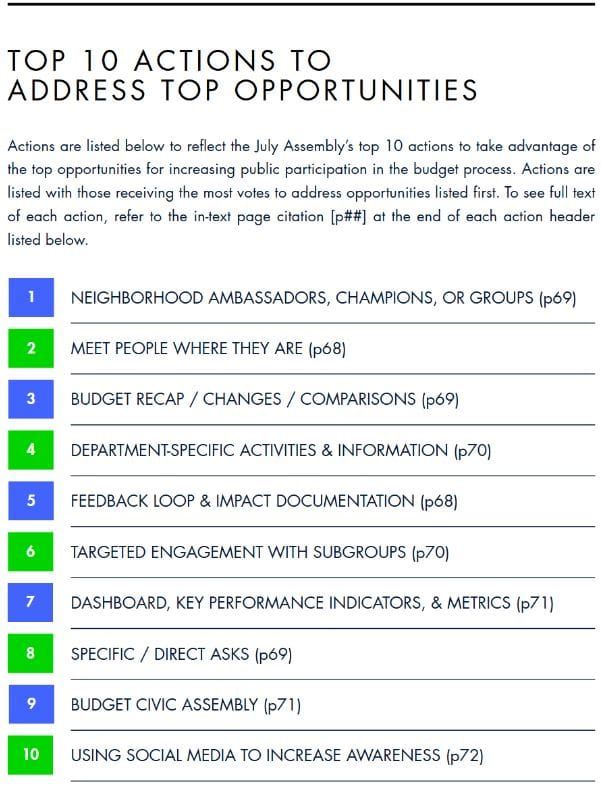
The presentation to city council highlighted the 10 specific actions decided upon by the Civic Assemblies as the most pertinent opportunities to improve participation in the budget process. Many of these focused on fostering a stronger connection with the public by expanding outreach efforts, simplifying or providing resources to help residents understand the budget, and creating ways for residents to connect their feedback to action taken by the city.
The biggest priority overall was the same as presented last Monday night: meeting people where they are. Targeted engagement towards neighborhoods and city subgroups like business owners was a key piece of several of the top recommendations provided by the Civic Assembly.
To read the full report, click the link here.


Comments ()