
Culver City kicks off budget season with new look
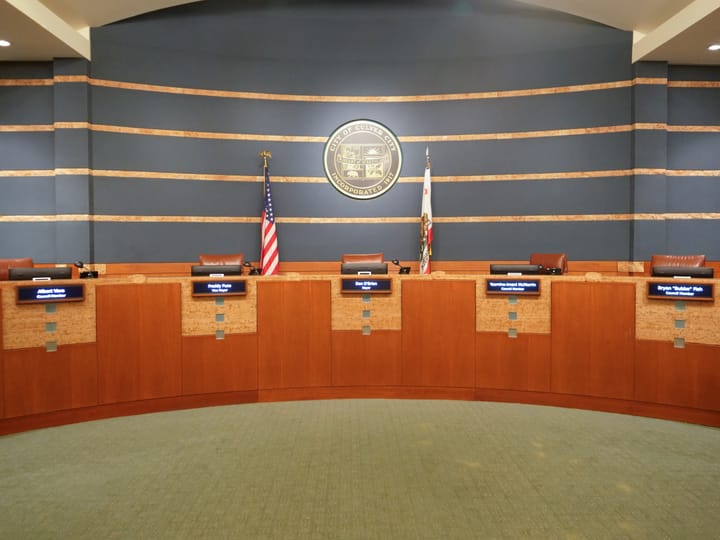
The City Council began its initial consideration of the 2026-27 Fiscal Year budget cycle by considering two new features of this year's budget formulation process

The Culver City City Council considered two new aspects of the city’s budget formulation: a priority-focused approach and demographic targets for the Civic Assembly process, both to be introduced this budget cycle. Mayor Freddy Puza and City Manager Odis Jones have proposed this priority-based budget process to improve how the city allocates money, while Vice Mayor Bubba Fish first introduced the Civic Assembly model to formally gauge resident opinion on how the budget process could be further improved and made more accessible.
A paper published by the Government Finance Officers Association in 2021 outlines the anatomy of this process, which diverges from traditional incremental budgeting that uses the previous year’s budget as a base and makes only minor changes each year. There are eight distinct steps in this process that guide the identification of the city’s resources and priorities, rank programs and services based on their role in meeting those priorities, and allocate the city’s expenditures accordingly.
“[It] will help us articulate why the services we offer exist, what price we are going to pay for them, and what value they offer the citizens,” Chief Financial Officer Lisa Soghor said Monday night. “We are going to try to do the important things well and cut back on the things we are deeming less important in this moment.”
The city has outlined priorities before, most recently in adopting the 2024-2029 Strategic Plan. This plan highlighted nine pillars to guide the city council's actions, which will be evaluated and applied based on the city’s current needs. Mayor Puza also proposed a Strategic Planning Special Meeting in February to further refine these goals.

With a new process comes a new schedule. Workplan meetings, where departments present their workplans to the council and public, normally held in March will not be a part of this year’s process. These will be replaced by community meetings where city staff will engage the public on the council-established priorities for this budget cycle. A Special Council Meeting will be held in February to set the council's priorities, and those community meetings are tentatively scheduled for March.
There will be another Special Budget meeting in April, during which the council will receive and consider input from the community meetings before the final steps of the process. California requires that budgets be presented to the city council 45 days before implementation, which will be on May 11, and the budget will be adopted during a public hearing in June.
Running parallel to this new process is the Civic Assembly, which will provide recommendations from a citizen panel on ways the city can further improve its budget process and make it easier for Culver City residents to participate. A subcommittee worked with the consultant selected last year — the Center for New Democratic Processes (CNDP) — in mid-December and early January to help determine these demographics, which is the first step towards creating the semi-random, 30-person panel that will make up Culver City’s first Civic Assembly.
These demographics serve as targets for creating the final panel during the sortition process, which randomly selects a panel from among various arrangements designed to achieve the desired demographic balance. While the panel’s size makes it difficult to create a perfectly representative sample, the process uses an algorithm to generate several panels guided by factors such as gender, age, employment status, and political party affiliation.
“They will [be used to] invite a broad cross section of the community together to be engaged in the Civic Assembly process,” CNDP Executive Director Kyle Bozentko said at Monday’s meeting.
This information is primarily drawn from the American Community Survey, a research program run by the United States Census Bureau. Party affiliation data was drawn directly from voter registration records, while data from the 2024 California Health Interview Survey was used to determine gender demographics.
While this data set is robust, it is not a perfect guide. In response to community feedback, Puza asked about how the survey represents those of Middle Eastern or North African descent. CNDP Director of Research and Engagement Sarah Atwood explained that collecting race data has historically been complicated.
“We don’t see alignment across data sets in the ways that represent how people identify,” Atwood said. “They are truly imperfect tools.”
Random households will receive mailers inviting them to participate in the body, and the city will sort the interested respondents into semi-randomized panels using these demographic targets as a model. Participants will be compensated for this work, with a current estimate of $1,350 ($30 per hour for 45 hours) per person, or $40,500 total.
Councilmember Yasmine Imani-McMorrin brought up disabilities as a demographic to consider. However, she explained that in her experience working on these surveys, many respondents are hesitant to come forward about their accessibility needs because there is not enough time to build the trust needed for people to open up.
“A lot of times, people do not disclose accessibility needs up front, even when they have the option to do so,” Atwood explained, “but there tends to be a level of trust or accountability that participants expect of us, and then choose to disclose that as they feel comfortable or as it is required for their participation.”
The questions that the members of the Civic Assembly will deliberate about and base their recommendations on will be brought to the city council at a later date. For the full list of demographic details used, click here.
Comments ()