
Culver City working to shape Arts and Culture strategy
Culver City's Cultural Affairs Commission is seeking input from residents as it formulates the Culver City Community Cultural Equity Plan

Culver City is reexamining the direction of arts and culture across the city, but not without hearing from the city’s residents.
The Culver City Community Cultural Equity Plan — a document that aims to provide equitable long-term direction for the creative economy and culture through funding, policies, and programming — is a collaborative effort between the Cultural Affairs Commission, the city, and a team of consulting experts from CVL Economics and MIG.
California’s state law mandates that each city adopt a long-term general plan for development and land use. Culver City’s General Plan 2045, in addition to the required legal blueprints for development, included the mandate to create a cultural and art plan.
In addition to developing a strategy to improve cultural programs and the city's creative ecosystem, the Cultural Plan will include a Public Art Master Plan to guide funding and ensure equitable access to public art across all neighborhoods in Culver City.
Forming a more unified approach to Culver City’s creative industry and economy means recognizing both the city’s legacy in filmmaking and the growing presence of digital media. Through MGM's success during the Golden Age of Hollywood in the early 1900s to digital media studios throughout the city today, creative professionals have been a significant part of the city’s workforce for over a century.
In 2017, a report by the Los Angeles Economic Development Corporation (LAEDC) breaking down data from 2005 to 2014 shed light on the impact that the creative industry had on Culver City’s economy. LAEDC’s document reported that 14.4% of workers in Culver City were in the creative industry, 4.4% higher than Los Angeles County. With over 8,540 workers in the creative industry, the total direct payroll amounted to over $1.1 billion.
Vice Chair of the Culver City Cultural Affairs Commission, Tania Fleischer, recalled how the conversation changed the way the city viewed the arts.
“[LAEDC’s report] made people, especially people who run the city, aware that creative businesses really contribute so much to our creative economy, [and] to our economy, period,” Fleischer said. “It helped set the tone for how the arts can be supported. We really gained the visibility of the arts in Culver City.”
In the decade since the report, large brands like Amazon, TikTok, and Pinterest have opened studios and offices in Culver City, furthering the city’s image as a hub of cultural and artistic activity. Developing a Cultural Plan, according to Fleischer, will provide a cohesive approach to art in the city.
In order to ensure the Cultural Plan fulfills the city’s efforts to develop a fair and accurate representation of what people want to see in the future, MIG has been collecting feedback from the artistic community. Meetings with stakeholders like performers, artists, nonprofits, and others in the creative industry will help shape the Cultural Plan.
Ann Berchtold, Director of Public Art and Placemaking with MIG, explained that meeting with creative professionals is important to understanding where Culver City is currently.
“We wanted to get a voice for the whole spectrum of the cultural scene in Culver City,” Berchtold said. “We’re trying to understand from the community what they love about the [ongoing art and culture programs] and how they could maybe be improved or strengthened or broadened.”
In addition to meeting with the community involved with the arts, the project team has been reaching out to the public through a series of pop-ups at various events. Noé Noyola, a Community Planner from MIG and the Engagement Lead for this project, said that he organized a pop-up at Westfield Mall in Fox Hills for a specific reason.
“We certainly want to have as wide an array of participants as possible,” Noyola said. “The reason we were at that mall was that we wanted to get beyond the typical people that would participate.”
Many events organized by the city, such as the Summer Sunset Concert Series that ran from July to August, take place in downtown Culver City. To reach other demographics, Noyola noted, they had to consider different ethnicities and neighborhoods often overlooked, such as those who live and spend more time in Fox Hills.
Fleischer echoed Noyola’s concerns, noting West Culver City as another neighborhood that could use more artistic and cultural focus.
“I’m hoping that the Plan can help figure out ways we can support these communities,” Fleischer commented. “Give them the cultural experiences they would want in their own communities.”
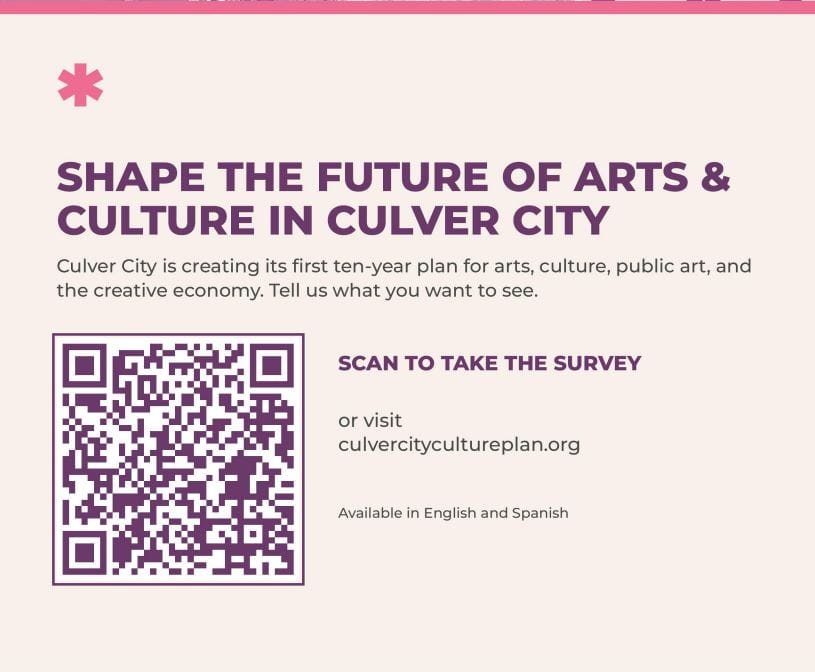
When reaching out for public feedback, participants are asked to fill out surveys, answering questions ranging from which neighborhood they live in to the types of art and cultural programming they would like to see in the future. The MIG and CVL team hope to reach at least 400 completed surveys, encouraging people through QR codes posted throughout neighborhoods and pop-ups at events like the Fiesta La Ballona.
Adam Fowler, an economist at CVL Economics, explained that the surveys are a way for people who might not have as much time or don’t feel as heard to make their voice heard.
“Culver City is asking a lot of its people,” Fowler commented. “We want to have done our work so that [residents] don’t file this away as ‘Oh, I took a night, or did the survey and yet still feel like everything’s a status quo.’”
“Here’s where you can look for some accountability on seeing it out in the real world – that translation of values into something.”
To learn more about the Culver City Community Cultural Plan, visit their website. The survey to provide feedback will remain open until at least 400 people have completed it.

Comments ()