
Four Takeaways from CCUSD's 2026 State of District
Superintendent Alfonso Jiménez updated the public on a wide range of District affairs during his address last Thursday
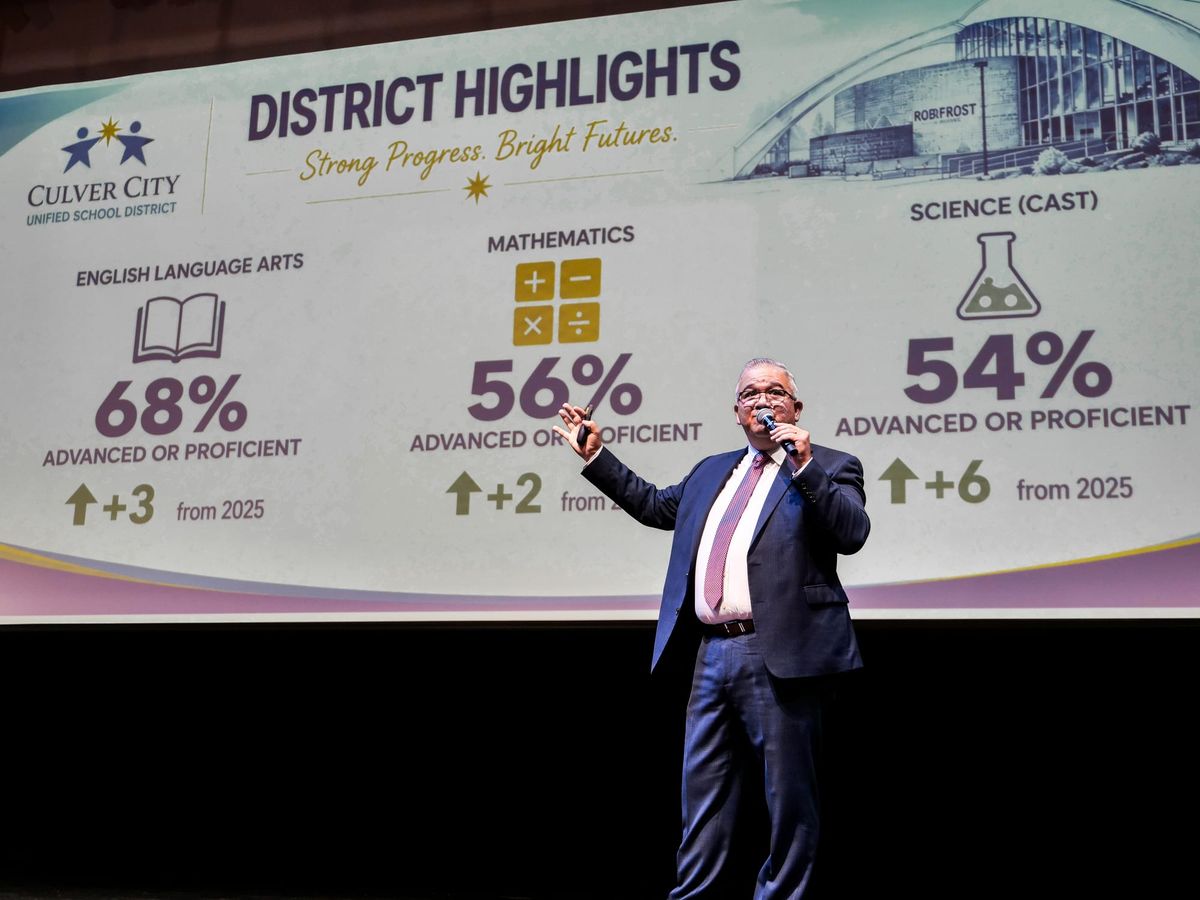

Culver City Unified School District Superintendent Alfonso Jiménez presented trends moving in the right direction and plans for the future at the 2026 State of the District Address held at the Robert Frost Auditorium last Thursday, September 17.
In addition to highlighting several students, groups, and clubs with notable achievements in the 2025-26 school year, Jiménez discussed improvements CCUSD made over the past 12 months and plans for the future.
The 2025-26 school year was Jiménez’s first full year as CCUSD’s top administrator following the sudden retirement of previous Superintendent Brian Lucas. He presented his summary of the District and the progress it has made since he started to community members at the public event, including members of CCUSD’s Board of Education.
Here are some of the takeaways from Thursday night’s presentation:
Refocusing Values
At the core of Jiménez’s message were the efforts to strive towards the values tied to CCUSD’s mission, but what exactly was that mission? Jiménez pondered that question and reflected on the District’s mission statement during his address last Thursday.
“We have a lot of core values, 12 to be exact,” Jiménez said. “We can get these down to a good set of five or six core values that everyone can agree upon.”
The District has focused its goals in the past, including during its most recent superintendent search. Stemming from those core values were three primary goals for the incoming superintendent search: advancing academic success through quality instruction, creating and maintaining an effective organization to serve students, and fostering thriving community partnerships.
One value consistent across the District is the focus on student outcomes. In addition to highlighting the many universities that the most recent class of Culver City High School graduates are set to attend, Jiménez featured individual students and groups who achieved notable success this year during his address.
Among them was Christopher Tomasz, a member of Culver City Middle School’s Speech and Debate Team, which was highlighted for making it to Richmond, Virginia, for the National Speech and Debate Association’s National Tournament. Tomasz delivered a short “informative speech,” reflecting on the state of boredom while demonstrating the skills the Speech and Debate team fostered that brought him and his fellow club members to the national stage.
Key Metrics Inching Upwards
One of the main highlights in Superintendent Jiménez’s presentation was a move in the right direction in what many see as the most critical metric of school success: academic participation and achievement.
Participation in AP classes among the African American student body also saw a big jump in the 2025-26 year from 40% to 49%, and the percentage of students who scored a passing grade of 3 or higher also saw a significant jump from 33% to 52% this year.
This metric was proposed as one measure of success for the College Prep English Course, which aimed to level the playing field for all learners, but low enrollment in AP classes contributed to the decision to reinstate an Honors-level course for 10th Graders in English.
This year’s significant jump moved that metric from trailing other groups to on par with the rest of the student body. This new parity in success across demographics is seen in the District’s standing in statewide metrics, with CCUSD being one of only two L.A. County school districts to receive one of the top two possible ratings in all areas of the California School Dashboard.
These metrics are determined in part by student performance on the California Assessment of Student Performance and Progress (CAASPP). CCUSD saw improvements in all three major subject areas analyzed by CAASPP tests: English/Language Arts, Mathematics, and Science. The percentage of students who tested as Proficient or Advanced in these subjects increased by three, two, and six percentage points, respectively.
Another crucial data point is the attendance rate at CCUSD schools, which plays a significant role in determining the amount of funding the District receives from the state each year. An attendance rate of 95.4% districtwide is marginally higher than 95.1% in 2023-24, but Jiménez said the district can secure extra funding by educating parents about how the state’s attendance policy works.
“If you bring your child to school, then take them to their doctor appointment, we get funding for the full day,” Jiménez explained. “It didn’t used to be that way.”
Facilities Work Moving Forward
Plans to improve and modernize Culver City schools are moving forward, and onlookers will soon see the first tangible steps in that process.
Banners are being hung at facilities around the District that are soon set for physical improvements funded by the bonds approved by voters in 2024 through Measure E. Jiménez said that if you see a banner at a school related to a new construction project, it indicates that the district hopes that project begins by the end of the year.
Some of the projects funded by this money that Jiménez mentioned includes a new gym for Culver City Middle School, two-story buildings at La Ballona Elementary and El Rincon Elementary, and new facilities for El Marino Elementary and Farragut Elementary.
The District relinquishes some control of bond spending to a separate committee staffed by community members, which is primarily responsible for managing and monitoring Measure E spending.
Members of the public have asked Jiménez for updates on the state of bond measures in the District, but Jiménez said they don’t need to rely on him for these updates. Extensive detail on the weekly progress of projects funded by Measure E bonds is available for public viewing on the CCUSD website.
“Everything is there,” Jiménez told the audience. “Week by week, play by play, picture by picture.”
The Inevitable March of Technology
The influence of Artificial Intelligence on all aspects of life, including in CCUSD schools, is undeniable. California has taken significant steps to curb the influence of AI and technology as a whole on classrooms in the state, and Jiménez highlighted 2024’s Assembly Bill 3216 and 2026’s Assembly Bill 2148 — which required a cell phone use policy in schools and requires teachers in California to be “natural persons” and not artificial intelligence.
Jiménez argued that the conversation should start with how AI is perceived and used, which will dictate how it is used to help kids in the classroom. He pointed out that many people still have limited exposure to artificial intelligence technologies, and that many of the possibilities that come with AI are not being taken into account as many parents and residents analyze its pros and cons.
Projected onto the backdrop of the Robert Frost Auditorium stage was a range of AI products that serve a variety of purposes and industries. Jiménez asked the more than 50 people in the audience how many of them had heard of these technologies, and none could recognize even half of the products he presented.
“I see AI as a way of providing equity and support for students at different levels,” he said.
Another recent technology-related change in the District is the implementation of a new cell phone policy. The slogan for CCUSD’s approach to limiting cell phone use is “away all day,” indicating that phones are expected to remain stowed away while at school.
“We hope to see positive outcomes with distractions,” Jiménez said of the new policy.

Comments ()