
Racial Equity Action Plan findings presented to public
Responses from City employees on their feelings of comfort and inclusion in the workplace were made public at at meeting Monday afternoon
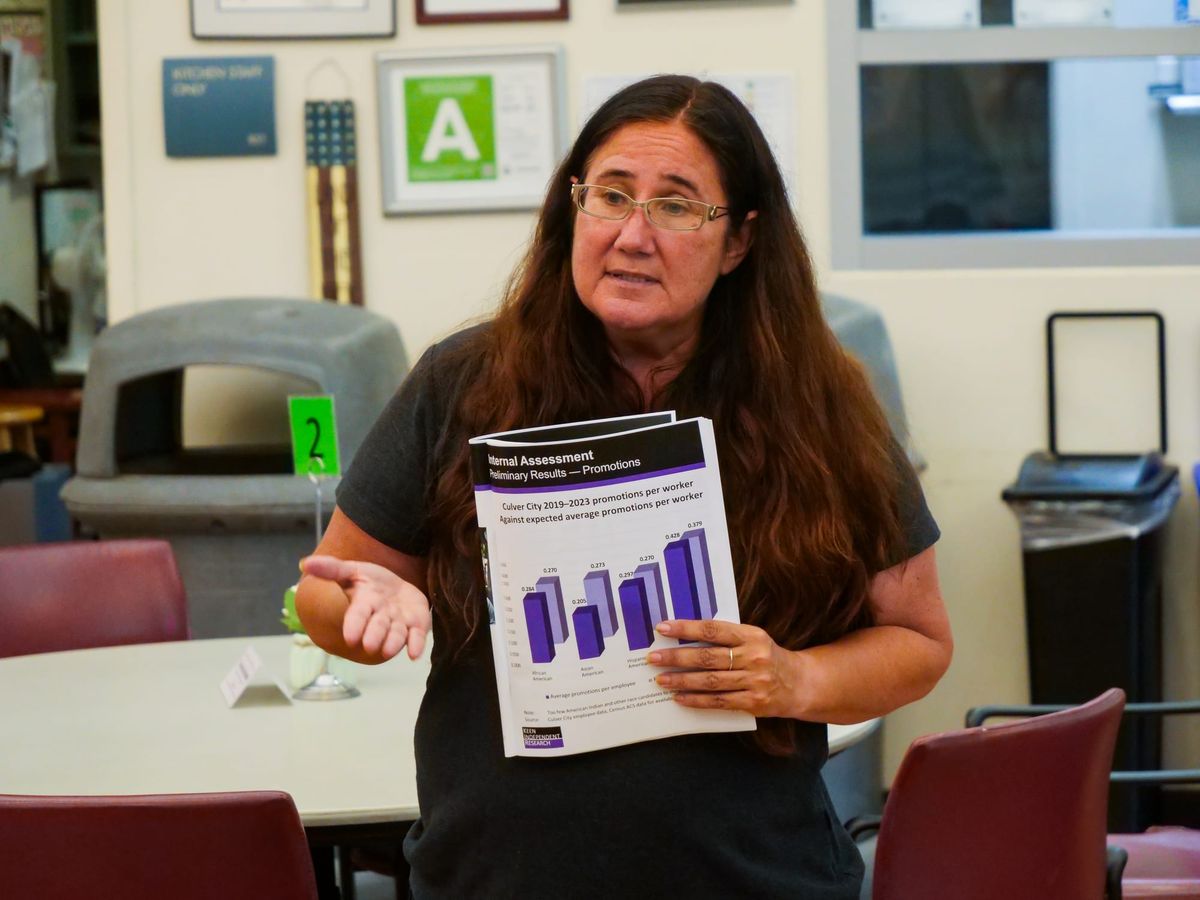

The city presented the preliminary findings of its Racial Equity Action Plan (REAP) at the Culver City Senior Center on Monday afternoon, including survey results that gauged the feelings of Culver City employees. While the name suggests a focus on race issues, community feedback prompted the team behind the plan to expand its scope to encompass overall diversity and inclusion, including gender identity and sexuality.
These survey results were the core of the presentation to a small crowd of seniors on Monday afternoon. Questions about employees’ comfort in the workspace yielded mostly positive responses, but room for improvement remained clear. The work from these internal workshops, along with feedback from the community incorporated through outreach, will be compiled into formal recommendations expected to be presented to the city council in mid-July.
For most questions related to the Culver City workplace and its ability to support its workers, a large majority voted in the affirmative. They were presented in statement form, and each statement was answered on a 1-7 scale. Many questions had a majority of respondents giving scores of 5, 6, or 7, indicating agreement with the statement to varying degrees.
One of the more interesting discrepancies pointed out by Jeannine Houchen, a Senior Management Analyst for Human Resources, is the differing views on leadership’s support for Diversity, Equity, and Inclusion in Culver City. While 62% of responses to a question about an employee’s supervisor supporting DEI were 7, that number decreased to 44% when the question focused on city leadership as a whole.
There are not as many opportunities for staff to see councilmembers and other city leaders act in support of this initiative because of the lack of interaction in the workplace stemming from their different roles, Houchen explained, leading to a potential disconnect between the city's top brass and its workers.
Other areas where satisfaction was not overwhelming include the Human Resources Department's responsiveness to complaints, with more survey participants rating their response time as average. Additionally, while many of the questions asked had an agreement rate (score of 5, 6, or 7) above 60%, that result wasn’t as consistent when accounting for individual demographics.
While about three in four employees agreed to statements such as “I receive the support and resources I need to be successful in my role at Culver City” and “Culver City’s workplace policies are fair and support equitable treatment of employees,” that number is less consistent across demographic groups. For these questions, the agreement rate among women, nonwhite, and LGBTQ+ employees fell below this threshold, indicating room for improvement.
The report also included more specific feedback, some of which tells a different story from the survey results. Included among them were concerns that favoritism was practiced in the Culver City workplace, some more extreme than others.
“There is inconsistent training, lack of career development opportunities, and favoritism that dictates access to resources,” one response reads.
“…most decisions are made by white people, which makes it harder for Black and Hispanic employees to get chances to grow,” another said. “There are not many opportunities for them to advance, and they are often overlooked when it comes to leadership roles or important projects.”
The culmination of this feedback will be the formulation of formal recommendations to be presented to the city council to address concerns identified during the plan development process. According to Houchen, these recommendations will be presented to the council in mid-July.



Comments ()