
Culver City's parcel tax effort reaches significant milestone
Efforts have advanced on several fronts to pass a parcel tax in the November 2026 election to raise funds for the Culver City Unified School District
The picture around Culver City’s potential new parcel tax is starting to take shape.
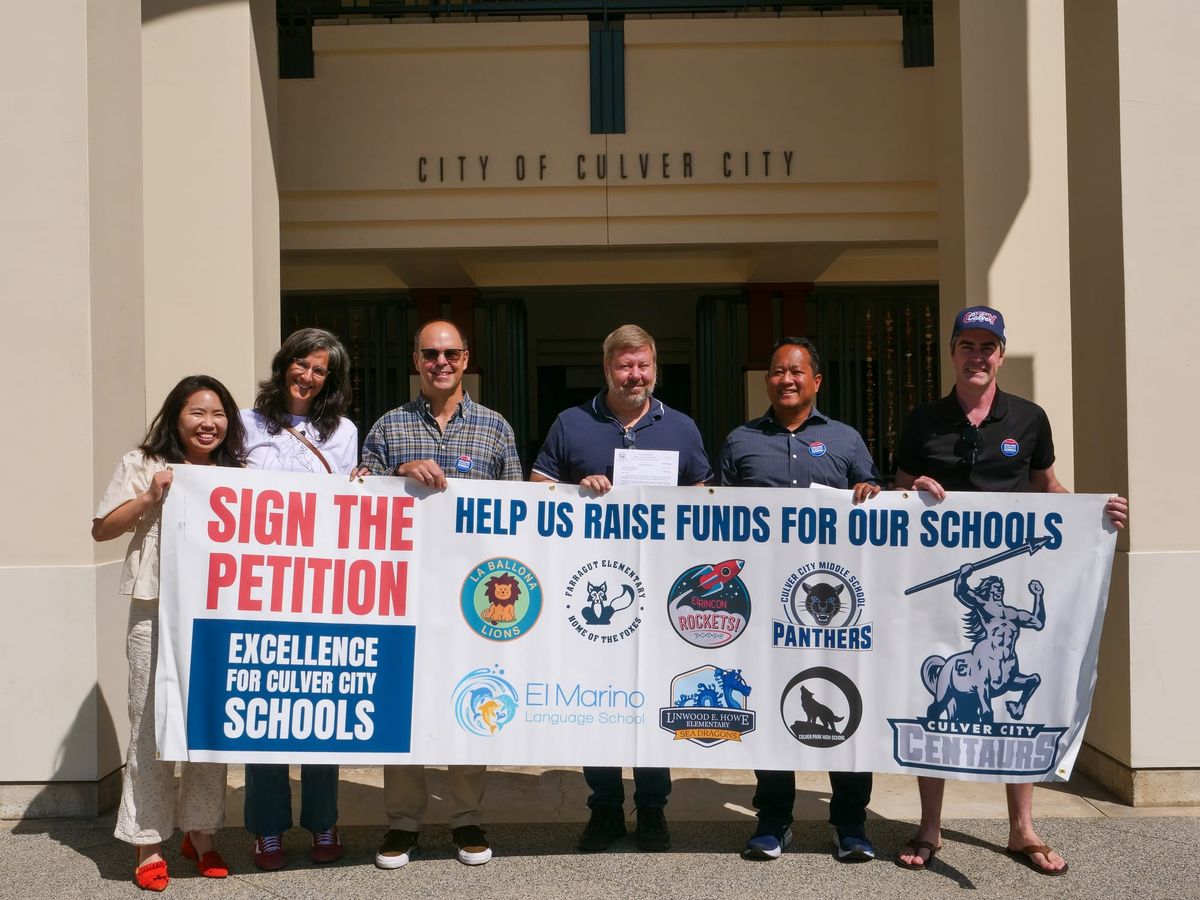
Excellence for Culver City Schools, a volunteer-based coalition that proposed and gathered signatures for a citizens’ initiative parcel tax measure, successfully submitted those signatures to Culver City last week. If the minimum required 2,912 signatures of the more than 4,000 signatures submitted are deemed valid by Los Angeles County, the citizens' initiative parcel tax will appear on the November 2026 ballot.
If passed in the November election, it will implement a sliding scale parcel tax to generate much-needed funding for the Culver City Unified School District. The parcel tax proposed by EFCCS is a sliding scale that charges $0.48 per square foot of improvements on parcels of land in Culver City to raise money for CCUSD.
District officials are also preparing to place a similar parcel tax measure on the ballot, but a citizens' initiative is far easier to pass than one proposed internally. While a measure put on the ballot by CCUSD would require at least 66% of the vote to pass, a citizens’ initiative only requires a simple majority, or 50% plus one voter, to be enacted.
In order to successfully submit a citizens' initiative ballot measure, it must be submitted with a number of supporting signatures equal to at least 10% of the voters in Culver City, based on the latest report by the California Registrar’s Office when the intent to circulate the petition was submitted.
For EFCCS, this meant a minimum requirement of 2,912 signatures. However, the coalition set a goal of 4,000 signatures to demonstrate the initiative’s viability in the November election and to account for potential issues with signatures.
This planning proved prudent, as several potential hiccups were encountered while counting on Thursday. The regulations and requirements for gathering and submitting signatures are strict, including requirements to include the full text, additional supporting documents, and the signature and information of the gatherer for each set of signatures.
In addition to counting the signatures, the county will also verify their validity after the city’s initial review. Signees must be registered voters in Culver City, and the county will verify that signatures are unique and match Culver City voter information.
Even without all of the signatures, the minimum threshold remains attainable. While the city only counted the ballots up to the required 2,912 signatures, a significant number remained uncounted before the city accepted the submission on Thursday. EFCCS representatives told city staff they had gathered 4,230 signatures, 145% more than required and representing 14.5% of the 29,169 voters registered in Culver City as of the May 18 Report of Registration.
As part of the District’s efforts to place their own parcel tax on the ballot, should the citizens’ initiative fail to make the ballot, polling was conducted to gauge the viability of the measure at various levels. CCUSD tested parcel taxes with similar scaling, but at a much lower rate than the citizens’ initiative. While EFCCS’s parcel tax initiative sets the rate at $0.48 per square foot, the district polled at $0.06, $0.09, and $0.12 per square foot, respectively.
These parcel tax rates are expected to generate $2.5 to $5 million for the district, which does not generate the level of revenue some board members hope for. Board Member Lindsay Carlson asked why the polling was done at such low levels, especially when considering almost $3.5 million in revenue in the form of property tax passthroughs as part of the dissolution of the Redevelopment Agencies in California will be discontinued in 2028-29.
"Even if we passed a parcel tax at those low amounts," Carlson said, "we would still need to make even more cuts in a couple of years...or go back to our voters yet again and try and pass another piecemeal parcel tax."
Paul Goodwin with consultant TeamCivX said that school districts generally cannot generate all the revenue they need from a parcel tax in a single measure, so these levels were proposed as the starting point for incremental parcel tax increases to maximize the chance of securing the necessary 66% vote for passage.
Even with these lower numbers, the district did not reach the 66% approval threshold for any of these rates, with the $0.06 tax receiving 61% approval among the 543 survey participants. However, all three rates met the simple majority threshold required for a citizens’ initiative to pass.
In addition to the projected support the parcel tax would receive, the survey also gathered information on residents' views of the Culver City Unified School District and its funding levels. Most voters recognized the funding issues within the city, as 59% of voters surveyed . However, these figures vary by demographics, and those with direct ties to the District polled higher than others.
The strongest proponents of the parcel tax were parents, with 80% of those surveyed believing the District needs more funding. Renters also tended to lean more toward the parcel tax than homeowners, and support for it declined among older age groups. However, no demographic fell below the simple majority threshold for the $0.09 parcel tax.
For volunteers with EFCCS, the need to raise funds for schools at home is pressing as ever with President Donald Trump’s administration and Governor Gavin Newsom’s withholding of Proposition 98 funding due to California’s public schools. For parents looking to support the vibrant learning environment that many families came to Culver City to allow their children to experience, this November’s decision is crucial.
“We are in an environment where the federal and state governments are cutting education funding left and right,” EFCCS volunteer Ross Piro told Culver Crescent, “so the only place we can look to find a way to weather the storm is to look for local funding.”



Comments ()