
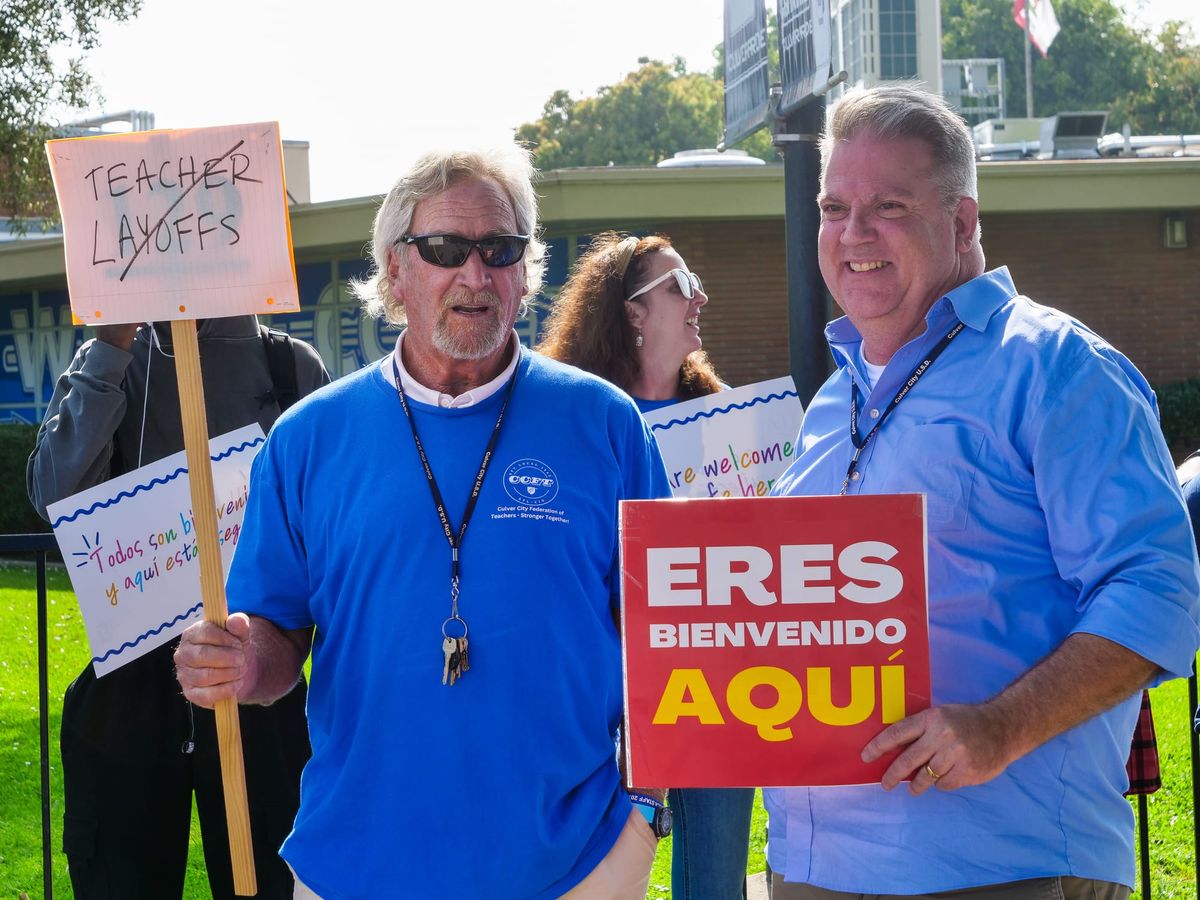
Culver City Unified School District Board of Education Candidate Brian Guerrero sat down with Culver Crescent Publisher Christian May-Suzuki to discuss his policies and positions for voters ahead of the 2026 General Election
The 2026 Culver Crescent Candidate Series is a key feature of our Voters’ Guide for Culver City residents for the November 3, 2026 General Election. As part of this series, candidates running for public office in Culver City sat down with Culver Crescent Publisher Christian May-Suzuki to share their thoughts and positions on the issues on residents' minds.
An edited transcript of these roughly one-hour interviews appears below. The length of these interviews was intentional, allowing candidates to contextualize their points and positions for residents less familiar with the scope of questions facing Culver City and CCUSD. For those more familiar with Culver City politics, key points and positions are highlighted throughout the transcript.
Brian Guerrero, Governing Board Member at Culver City Unified School District
I have a lot of school experience, whether it's the classroom or doing union work at schools or traveling around the states doing education policy and things related to it. That's an important voice to have on the board, and so I don't want to see us lose that.
Biography
Occupation
- Union Organizer with the California Teachers Association’s Equity and Justice Department, Former Teacher at Lennox School District
Hometown
- Bakersfield, CA
Time Living in Culver City
- 16 years
Why You Came to Culver City
We speak Spanish at home, and we’re raising our son as a native Spanish speaker. We wanted him to go to school in Spanish, too, and moved to Culver City so he could participate in one of the amazing CCUSD dual language immersion programs. No regrets.
CCUSD Involvement
- Current Vice President of the Culver City Unified School District Board of Education.
- Son attended CCUSD from K through 12 (El Marino, CCMS, CCHS)
Other Notable Involvement
As teachers and active union members, my wife and I were very involved in the community where we worked (Lennox) and not as much in Culver City until COVID, when we suddenly had more time to devote locally. We are mostly involved in Culver City activities through our son through things like AYSO, Culver City Little League, and AVPA.
One Thing You Wish More People Knew About You
I’ve lived outside the US twice for a total of 4 years. I went to college for a year in Mexico City, then taught English at a fancy private high school, and then served in the US Peace Corps for two years as a teacher-trainer in the Philippines. My wife and I did both Mexico and the Philippines together (married 30 years!)
Favorite Thing to Do in Culver City
My favorite thing to do - even though I don't have time to do it often enough - is to attend the various cultural and artistic festivals and events with my family. We love to travel and to go to museums, and when we have these festivals, it's like the world is coming to us. And who doesn't enjoy good food and free music?
Notable Endorsements (Full List Here)
- “Brian is a former teacher and union president whom I came to know through CTA activism. He is thoughtful and understands public education from multiple perspectives. He leads with integrity and a clear vision for all students and district employees.” - Ingrid Gunnell, Glendale USD School Board member
- “Brian is a school board trustee any school district would be lucky to have - intelligent, collaborative, and thoughtful. Not only has CCUSD benefitted from his experience as an educator and labor leader, he has been a valuable resource to countless other trustees across the state.” - Telly Tse, Glendale USD School Board member
Culver City
- CCUSD Board Member Stephanie Loredo
- CCUSD Board Member Triston Ezidore
- CCUSD Board Member Andrew Lachman
- Culver City Mayor Freddy Puza
- Culver City Vice-Mayor Bubba Fish
- Culver City AVPA Foundation President Deanna Newell
- Culver City Federation of Teachers
- Association of Classified Employees, Culver City
- Our Culver
- Culver City Democratic Club
Los Angeles
- Los Angeles County Democratic Party
- Stonewall Young Democrats
- LA/OC Building and Construction Trades Council
- Los Angeles County Young Democrats
- Westside Young Democrats
- Los Angeles County Democratic Party
- Los Angeles County Federation of Labor
California
- San Diego Unified School District Board Member and 2026 Candidate for State Superintendent of Public Instruction Richard Barrera
- California Working Families Party
National
- U.S. Representative for California's 37th Congressional District Sydney Kamlager-Dove
- Stonewall Democratic Club
- Western States Regional Council of Carpenters
- Laborer's International Union of North America
Campaign Website
Opening Statement
My name is Brian Guerrero, and I am currently a school board member running for re-election. For anyone who doesn't know me, I was a teacher for about 25 years at public schools just down the road in Lennox by the airport. I am currently a union organizer with the California Teachers Association. I did some union work when I was a teacher, and that evolved into a full-time position with the CTA.
I worked in the Equity and Justice Department. I read Ed Code and Ed Policy that comes down from the state, and I work with local union chapters on making sure they understand it, making sure they know what the changes are and how that might impact their members.
I ran for the board in 2022, and my son was a junior in high school at that point. He had gone through Culver City schools all the way from kindergarten to El Marino, CCHS, and then Culver City High School. I had the opportunity to start watching the school board meetings on Zoom during COVID, and after we started coming back and the meetings started being broadcast on Zoom, there were some things that I saw that I didn't really like.
It had less to do with the board itself, and more to do with staff giving the board what I felt was incomplete or sometimes even incorrect information, and that put the board in a position to make bad decisions because they had bad information to work with. I know about Ed Code, I know about high-functioning schools, and I wanted to get onto the board so I could hold staff accountable.
I was elected with two of my other current colleagues, and we spent the last four years really trying to build systems. I think we found the district probably in a less organized state than we assumed when we came in. There were a lot of practices that were really based on the way things had always been done and hadn't been updated in a long time.
A lot of things had kind of frayed a bit, and we've really spent the last four years trying to establish those systems, trying to build those systems, trying to build back the confidence of the community.
I think we've done a pretty good job — not perfect, obviously, and I think there's still a lot of work to do. I'm running again for school board so I can try to see this through and finish the job we started four years ago.
On the Parcel Tax and increasing Revenue in CCUSD
The parcel tax is a citizen-initiated process, and that's very important in the way the voting for it takes place. We did Measure O and Measure E in recent years, and those were district-initiated, so the district is allowed to endorse it and be involved. The district is not allowed to be involved in this parcel tax.
At this point, some of this is us still trying to figure out how much we're allowed to be involved in this. But I think because this is a political campaign, it is clearly not district-sponsored, so I can venture a little farther than I would from the dais.
Yeah, I think the parcel tax is great. I'm very appreciative of the proposal of a parcel tax. I really appreciate everybody who's stepped up and put this together. The main advantage of a parcel tax is that it is stable. Most of our money comes from state funding that can fluctuate a lot, which makes it very difficult to do long-term planning. It makes it very difficult to make long-term commitments to staffing or to programs.
When the state budget is uncertain, they'll sometimes throw us one-time money, but that's how we got into a little bit of trouble with COVID. The state and federal government gave us a lot of one-time money, and the board at that time made long-term commitments with that money, but that money ran out.
A parcel tax would offer us very stable money going forward. It is what a lot of upper-middle-class and wealthy communities do to support their schools. Santa Monica does parcel taxes, and so do a lot of other places. I think it is a positive, and it's certainly something that I will be voting for.
But it is not a panacea. It's not something we can count on for all of our challenges. We do have to be more efficient with things like purchasing and the processes we go through as a district, make sure contracts are as economical as possible, and deliver exactly what we need.
We need to keep reviewing our programs, looking at student data to see which programs are working well and keep those, and see which programs may not be delivering a whole lot of success and cut those.
We need to reduce outside contracts and bring more of the jobs back into the district. Outside contracts are more expensive. We need to look at revenue, and part of that is increasing our attendance. Not everybody knows we are paid by the state based on butts in seats, not necessarily enrollment, so we need to get our attendance up.
Our enrollment has dipped a little bit. California as a whole is experiencing declining enrollment, lower birth rates, kids moving out of state, families having fewer kids, and things like that. Culver City is definitely experiencing that; not to the same degree as the rest of the state, but it's here too.
Getting enrollment back up is important, but so is attendance recovery. The state has just made some changes about what we can do in a student's absence. We used to do Saturday school so they could make up the day they missed. We can actually do afternoon attendance recovery now and pick that Saturday school up in smaller bits on top of Independent Study.
We can work with the city to use the facilities and make some money. Governor Newsom and the legislature ultimately withheld $3.9 billion from public schools guaranteed under Prop 98 in the state budget this year, which translates to around $3.9 million for Culver City.
That would have closed our budget gap. Had we gotten that money from Newsom and the state legislature, we wouldn't have had to make program cuts. We wouldn't have had to lay people off. We wouldn't have had to cut positions. Unless we have a more stable source of local funding, we're just stuck riding the waves that come from the state.
There are a lot of things we need to do on the revenue side, but I definitely think the parcel tax would help, and it would be stable.
On Creating or Bringing Positions Back
We don’t want to bring back every position. Some of these positions have lived their life cycle, and it was time to move on from them anyway. Some positions were cut because we have a little bit of declining enrollment. It's been a little bit each year, and we haven't adjusted for it for five or six years, so there's some space that's developed.
But as far as things that we lost that I think are really important to bring back, I think the first one is arts coordination. The arts are extremely important to me. I actually voted against this cut, but I didn't prevail. I think we have good arts going on at elementary, good arts going on at the middle school, and good arts going on at the high school.
We have enough variety of programs, financial tools like grants, and partnerships with outside agencies that it's important to have some kind of coordination that's going all the way through, so bringing back that arts coordination is important, but maybe not in the same form that it was.
In the same way we have an athletic director that coordinates athletic activities, it's important to have a position responsible for coordinating arts programs. Maybe it's not an administrator, but that role is important.
For the record, some of the biggest cuts were from management. We did commit to keep cuts away from the classroom, and at some point, there wasn't anything left but the classroom. Overall, we made more cuts to administrative positions than we did in any other category.
The most obvious for folks is the vice principals at the Elementary Schools that were cut, but there were also a number of cuts in the District Office. It has begun to show a little bit; things are happening more slowly because there are not as many hands in the District Office. Principals are definitely taxed for their time and all the different responsibilities they have.
I think exploring bringing back some of the Assistant Principal positions in some form is worth looking at. Classified staff took a lot of cuts; that may not be as obvious as a teacher position that's cut.
One of the ones that jumps out at me that I would like to see come back is technology support positions and technology aides, because without that, teachers don't have the support they need.
Their computer doesn't work. They can't log into something and stay testing. There's not as much support to go around, but the people who are still around have been doing a really good job of hustling that. That's one area where I'd like to look at maybe bringing some of them back.
Most of the teacher cuts ended up being positions that we had to reduce because there just weren't the students to sustain them anymore. Fortunately, we were able to rescind all of the layoff notices required to be given by the end of the year.
Some teachers moved on anyway because they had done another job, but attrition — when people retire, when people get married and move away, or decide they want to go somewhere else — enough of that happened on its own that we were able to bring back all of the teachers who had gotten preliminary layoff notices.
The other thing that is important to mention here is that I don't think we want to bring back every position. As we fix the budget or more money becomes available, we also need to do a better job taking care of the staff we have, whether that's training opportunities and support for things like planning time or collaboration time, or just salary increases.
Our staff went three years without salary increases. Benefits are getting more expensive for the district, but also for employees. We need to take care of the folks that we have as well.
Instead of just running out and hiring a bunch more people, we have to be really careful when we hire that we're hiring with permanent money, so that we're not facing this same situation again of building a program and then having the money disappear for it.
On the state of Mental Health Services in the District
With the help of the Culver City Education Foundation, we were able to restore some of those positions, so in the end, we ended up only losing one. It is still a cut, but it's not as drastic as what was originally proposed, so I feel good about that.
I believe, frankly, we're in a better position than most school districts.
A lot of school districts, when they got that COVID money, really invested in student mental health and counseling, but when that money dried up, they cut those positions. A lot of mental health folks, a lot of social workers, and a lot of school counselors ended up getting cut statewide.
We chose not to do that because we felt that was important for our students, but part of the reason why we ended up in the budget deficit a few years later is that we held onto those positions longer than most districts.
Making those cuts is hard, because how do you tell a family, "Oh, I'm sorry, I know your child's struggling with something. We don't offer that anymore.” We really did hang on to it longer than others. In the end, though, the state doesn't fund these positions, so it puts us in a situation every year where we have to wonder about how we are going to fund this.
CCEF did a great favor by supporting one of these positions, but that's not enough. This is where the the parcel tax comes back in; the community has to decide whether or not is this something that we want to offer? Because if it is, there's no state funding for it.
We might find a grant or turn to CCEF again for a little bit of it, but if we want to provide wraparound mental health services for our students, there needs to be a community contribution to help do that.
I think we're able to do, like I said, a lot more than a lot of other districts, but it’s probably not enough.
On the state of Diversity, Equity, and Inclusion in the District
We live in a multicultural society, and you must value that.
Still, I was never a big fan of the Assistant Superintendent of DEI, only because as a classroom teacher and as a union person, I'm always a little bit skeptical of solving problems with another administrator, with another manager, and especially not a top-level one.
There were some folks who felt that having it be a higher position demonstrated the importance to us, but it was also really expensive. One of the conversations I have with a lot of parents and folks at the school site was that this is something we have to absorb. It's great to have the captain of the DEI team, but it's got to be something in everybody's daily practices, not heroes and holidays and that kind of stuff.
It's important we continue offering our teachers training, time, and space to figure out how this is impacting them. We have to do better with supply budgets. I actually just did a conference this summer organized a conference this summer on what's called “culturally responsive and sustaining pedagogy,” and part of that is students seeing themselves in the classroom.
When you've got students with disabilities or students from different heritages or forms of sexual identity expression and things like that, creating the environment where they see themselves once in a while takes resources. The books that a lot of teachers got when they started or collected over the years aren't as diverse. Some of it is just providing more money for resources.
We have to get better about disaggregating data on student outcomes. We talk about DEI, but if you're not looking at the data to see who's not experiencing the same level of success with attendance, suspension rates, academic algorithms, and things like that, then you're not really doing DEI.
You're just kind of waving your hands and celebrating and not doing the meaningful hard work.
We need to be better about disaggregating data, seeing where the struggles are in our student populations, and coming up with programs that are actually going to support that specific group of students instead of only doing programs that support all students, but seem to miss a few.
Doing those things is hard because it shows the weaknesses in your program. It shows the problems, but you've got to look at that if you're going to resolve it.
I think as a board, it's very important that we continue to support diversity and equity and inclusion. Whether it's some of it is performance, not in a bad way, but you've got craziness going on at the federal level about that kind of stuff.
I follow the Department of Education on social media, and it's nuts. It's like white Christian nationalism, Little House on the Prairie, back to the good old days kind of thing. Not a person of color to be seen anywhere. Let's make things great again, type of stuff.
That's the message that comes down, nd we've got to be pushing back against that by our own celebrations of diversity and our own equity work, and some of that is actually not ignoring it.
I think we're in a good place in California because the state government is pushing back on that kind of stuff. But they shoot out orders that say "starting tomorrow there will be no more of this or that," and it would be hard to ignore those if we were on our own.
But we're working with the state about just how much we can ignore and continue what we believe to be right and what we know is right for our students.
On the State of Attendance
I think we're actually bouncing back somewhat. Our attendance rate before COVID was around 97% on average. It's up to 95.7% today, and it's higher than the state average and the county average, but every percent is like $500,000 to $600,000, so it would be great to make up that last bit of space there.
In my mind, there are two groups of absent students. One group is the kids who are sick for a day or need a mental health day, or whose parents want to take them somewhere special for their birthday. Students who miss one or two days a year don't really disrupt anything. It's not a huge hit.
Yes, it would be great to encourage the parents to do that less, but I think one of the big lessons from COVID was just to stay home. You don't need to come and infect everybody, and it's okay to take a mental health day once in a while. We want to make sure that people aren't abusing that, but that doesn't worry me too much.
Working with those kinds of families to say, “That's great. Would you do an independent study for a day, and read a book while you're home sick or read a book while you're driving down to Disneyland and write a little paragraph about it or something to make up that work.” There are ways to recapture that.
I think the other group, though, are students who have those life challenges and are what are called chronically absent, which are kids who are absent 10% of the year or more, which is 18 days. When you think about that, that's only twice a month. If you're absent two days every month for the whole year, that adds up to chronic absenteeism.
We really need to work with those families and figure out what's going on. Is it transportation issues? Is it laundry issues? Is it that they're bouncing back and forth between multiple houses?
We need to look at and really drill into the data on which student populations or individual students or things are being impacted, and come up with programs to support those students, both because they're missing a lot of instructional time, and because we're better off having them here in school getting instruction, potentially qualifying for free and reduced meals and things like that.
I was a free and reduced lunch kid when I was in school, and if I didn't go to school, I didn't eat that day. Those things are important. There is also the financial side of things, where the state pays us for kids who are present at school. Using the money that we recoup by getting those kids to school to support those kids in some way.
At the same time, going back to that first group, if a kid's sick, they should stay home and rest. If a kid has had a tough week of tests or something and needs an afternoon, that's okay. I'm not a big fan of those old 100% attendance kind of things where kids are snuffling and sick and coming to school and things like that because they want that certificate so bad.
We should focus on the kids who are struggling and how we can support them.
On the State of Facilities and Priorities for Improvements
Every school in the District needs modernization.
They're all old, and Culver City took its eye off that for a while, and that's long before I was on the board. But it goes back a ways, and so I think every school needs to be modernized. We can't leave anybody behind, but I do think we also need to recognize the total price tag for modernizing all of our schools completely, and the way we'd like would cost more than one bond will cover .
This is really just the first phase of a longer-term revitalization effort that's going to take multiple bonds, and whether you're in the community college district or other school districts and other communities, places that have nice facilities, it's really part of this ongoing effort where every five to 10 years they do another bond and another phase of construction, and you want to plan it out.
What we think we're going to need in 10 years now is not necessarily the same as what we think seven years from now, so you don't want to plan too much. Still, you recognize that this is an ongoing, multi-year commitment kind of thing, and so we're not doing everything in one place. We're not going to take one school and put all the money into that one and leave the other schools behind.
Every school is moving forward with modernized classroom spaces, fixing up the roofs, fixing up the electricity and the outlets, and that kind of stuff. I think another important factor about this is Measure E, which was the facilities bond. really came at a time when there were some confidence issues with the district in the community, so it was a really big ask to ask the community to invest in the schools with the school board and school administration as it was at that time.
In a lot of ways, Measure E and the job that the school board now, and the next cycle of the school board does, is really a test and an opportunity to show the community that we can manage these projects and we can spend the money well. Former Assistant Superintendent of Business Services Santha Rajiv, who was our fiscal officer last year, did a ton of outreach with parents at every school site, asking about what they think.
A lot of Measure E is about doing that first wave of modernization, which will not be complete, but also building confidence in the community that we're doing it right. That comes into play five or seven years from now, when it's time to take another step in this ongoing process.
They will say, "Yeah, they did a good job last time. I trust them. I'm confident in them. I'm willing to invest that money in the school district and the schools again." A lot of it is just showing folks that we can do a good job.
You'll see things everywhere. My understanding is actually they got up banners like at each school site showing this is what the construction is going to be and all this stuff. But I wanted to make sure that they let people see this is what we're doing with this money that you're doing because if it just all happens behind closed doors, people think, “Oh, I voted for something, and then I never saw it.”
People need to know that their money is going to good stuff.
On Supporting Teachers in the Classroom
There's a gallows-humor joke among teachers that says, “Whenever you see a beautiful classroom, that's a classroom that a teacher paid for. If it's an empty classroom, that's one the government paid for.”
Teachers don't get enough money or classroom budgets to do all the things they need to do with their classroom. I think the issue of running out of Kleenex and stuff like that really bothers me as somebody who was in the classroom because I know the money is there, and I feel like in a lot of cases that is more of a purchasing issue and a distribution issue. It's not that expensive.
It's great to put out a wish list to parents and say, “Hey, I'd like some cool art supplies or something to really liven up the classroom,” and things like that. But I am confident the money is there for the basic necessities, cleaning products for the school and stuff like that, and that we're just fumbling with distribution and ordering and things like that.
When I came to Culver City, I was very surprised by how independently every school district operated. Putting in their own orders for things, having their own Xerox contracts and stuff like that. Where I used to work, it was all centralized to buy in bulk and get those discounts and things like that. So I think that's more of a distribution issue.
It is not okay when I go to a classroom for back-to-school, they're saying, "Please, we don't have toilet paper.” Somebody's messing up on that, and we've got to get that figured out.
On Honors Courses and Roles in Curriculum Development
Everybody's got a role in this process. I think it is absolutely okay for parents to express what they want for their kids, what they want them to be studying. I think it's great for students to be having opinions on this stuff.
I will be 100% upfront, though, in these types of questions about curriculum, I absolutely lean towards our experts, who are the classroom teachers. They're the professionals. They're the practitioners. They went to school to study curriculum instruction. Quite a few of them have PhDs in instructional design or related fields.
The same way that it's not great to be second-guessing your doctor and saying, "Oh, I looked up this article on the internet, and it says..." or second-guessing an attorney who knows what they're doing because you saw something on TV, it's important that we put some faith in our teachers who know what they're doing.
On the question of honors-level classes, our math teachers and our science teachers said that being able to separate things and have a college-prep group and an honors group works for them because math and science tend to be more linear.
You have to learn concept A so you can do B. You have to do B so you can do C. It works to accelerate that and to have some middle school kids taking high school-level classes and things like that because they're moving in a straight line faster. I trust them. They say that works for them, so great, do it.
Our English teachers said it doesn't work for them. They said they felt, in their experience and their expertise, that it worked better to have a single class offered in ninth grade and a single class offered in 10th grade, where they had all students of different success levels in that class, because language arts is more roundabout in some ways in the way you learn it, and the student who's not a great reader, and the student who may have an IEP, the student may not have mastered English; they can still contribute to the discussion about a piece of literature.
Maybe they access it differently. Maybe they're listening to it on tape or something like that, but they can have those high-level discussions even while they're working on their less developed reading and/or writing skills.
English teachers said the College Prep course worked as long as we keep the classes pretty small, which we did. I listened to them when they said that's what works, and thought, "That's good enough for me."
That is ultimately not the direction the board decided to go in; instead, they decided to reinstate a 10th grade honors class for English. The math and science were never going anywhere and never disappeared. The English teachers said they can work with that, in the end.
Tenth grade is part of your college application, so if they need the extra point on their applications. I can live with that. With ninth grade, I'm still listening to the teachers. I'm still hearing from the teachers that they want a single humanities core class where all students have the same experience, where students are learning from each other, some who are more advanced, and others who may be less advanced.
Ninth graders are 14 years old, and one of my colleagues actually used the idea of "those who have potential and those who don't.” I think it's very early to be sorting students like that.
We have some commitments to keep if we're going to do that about keeping classes small and offering support, but no, I don't support a ninth-grade segregated, separated, whatever you want to call it, ninth-grade honors.
On Arts, CTE, and Electives
Our arts programs are so well developed and so broad, we do need some type of articulation.
One of the things that I was talking with somebody about once recently is high school arts is like elite sports in some ways, where it's very difficult for a student to be in 11th grade and say, "I'd like to play baseball," because some of the kids who are playing baseball have been playing for 10 years at that point.
It’s not impossible, but it’s really hard to get into some of these things later, and I think arts are the same way. How do you build up students who are interested in doing the arts in high school, and how do you build up the diversity of the students who are in arts.
You introduce it to them in middle school, and how do you get the kids interested in it in middle school? You introduce it to them in elementary school, and so you open their experiences of those things as early as possible. I think that articulation is really important.
I would definitely like to expand our Career Technical Education (CTE) opportunities. My own son got one of the CTE certificates. He went through technical theater. I think they call it live events now, and that's what he's studying in college. He wouldn't be having the same experience now if he hadn't had those CTE experiences in high school, so I think CTE is really important.
I would love to see us have something like a culinary arts program. I would love to see us do something like a hospitality program. I would love to see us do maybe some more lab science CTE types of things.
One challenge with all of that is they do require specialized spaces, and so that's got to be something that we've got to plan for as we modernize and update buildings and things like that, creating spaces for that.
The other thing is we actually suffer from an embarrassment of riches. We have so many good electives that there are too many choices for students in a way, and kids go in too many different directions. When that happens, you don't have enough enrollment in any of them.
With our current schedules, there's got to be some controls on how many things we offer.
CTE is great, the arts are great, but the more arts and CTE you offer, the fewer students are going to be available to take other things. That's not a knock on CTE or arts, but we need to understand that as we broaden our opportunities, we are cannibalizing some of our numbers for other things, and we need to make sure we're good with that.
We're making good choices and basing that on student interest, basing it on usefulness in the future, basing it on college applications and what's going to help kids do better in college, be more prepared in college.
We have really good electives, and part of that is because we have a decent-sized population at that school. If we had fewer students at the high school, we would have to narrow the range of electives, and so making sure that we continue having a robust population at the high school is part of that too.
On CCUSD's Relationships with Outside Contractors
I don't think there's anybody in the district at this point who would contract out something as their first choice.
From a labor perspective, most of these positions are part of one of the bargaining units, and you're not really supposed to contract out bargaining unit members' jobs. You're supposed to hire people into the district as district employees rather than doing a contractor because it also tends to be cheaper.
They still get paid as a contractor, but then their contracting agency also has to take a cut, so a lot of times it's much more expensive to hire a contractor. One of the things that we sometimes run into with subs and aides who are contracted is you get a different person every day, so there's no consistency. You're not able to build the relationships.
I think everybody is recognizing that it's not great to have a lot of outside contracts. Sometimes if it's a quick thing, like if we need the tree trimmed or something like that and we need it done quickly, you hire somebody to come do that. The long-term contracts are not good for the district ultimately.
But at a recent board meeting, we approved a contract with an agency that provides subs for preschool. We need to have subs for preschool. If Preschool teachers call out sick or have a family emergency and they have to go do their thing, we have to provide a sub.
You have a lot of aides that work in classrooms or aides that provide support for special education. We must provide those, so if we're not able to hire folks internally to do it, then we have to get agency folks, and so I think part of it is making sure that we're constantly flying those positions, even if we've got agency folks, and that we're trying to replace those agency contractors as quickly as possible.
We don't just sit on it for a year; if we get a new hire on Tuesday, then on Wednesday the contract's done. Melissa Gooden, our previous human resources assistant superintendent, did a really good job at recruiting and filling those types of positions, and current Assistant Superintendent of Human Resources Hector Galicia is doing a lot of these hiring fairs now.
I think we have to keep doing that: recruiting and filling, recruiting and filling, and working with the classified bargaining unit, ACE, to figure out what's happening.
Is it just a shortage of people? I know when I first came on the board, we were having issues in the HR office that it was taking too long to hire people, and they were getting other jobs somewhere else. Is that still happening, or have we done better with that?
Is it the pay? Are we not offering enough? Do we need to examine that kind of thing, or look around to see if it is just a shortage of people? Is there something about the way we're offering it, the way we're flying it, the way we're hiring, the way we're training that is not attracting folks?
Of course, it’s important to make sure that once we do get people, that we treat them well and we pay them well, they stay, because it doesn't do us any good to spend six months looking for somebody to have them bounce out a couple months later because they found something better.
On Vote 16 and How to Encourage Healthy Civic Participation
I think before November, the district needs to stay out of it and stay away from it. That's true of any political kind of thing, but this deals with young people who are in our schools.
In many cases, it could get gray, and it's really important that it not get gray. The district just needs to stay out of it. It's a youth-initiated initiative, and I think it's great that they're doing that, but the district doesn't have any role in supporting it or opposing it or things like that.
I could see a teacher who's going through the various propositions or something, doing some pro and con exercises in class and debating or that kind of stuff, but we need to keep the thumb off the scales with that.
If it does pass, it's a great opportunity to again really ramp up our civic education, ramp up our work with students about understanding the news and propaganda and political perspectives about voting as a civic duty.
However, it is critical to be very careful not to weigh in on initiatives or to even appear to be swaying students.
I always find it somewhat amusing when people say schools are going to influence young people in elections. If we could influence them, they'd be doing their homework. If we could influence them, they wouldn't be vaping in the bathroom. We don't have that much influence on it. It's not like they're going to ignore us for everything else and go, “Oh, but they want me to vote for this? Okay.”
Personally, I supported it in 2022. I do think it is a good idea philosophically. I do think it's an opportunity for 16- to just under 18-year-olds to begin to engage in a political process in their home community.
I have not heard as much about it this year, so I have not officially said I support Vote 16 this year. I want to hear what the folks who are doing it have to say and how their campaigns are organized and things like that, but I am inclined to support it as long as they're doing a good job with it.
On attracting Culver City families to CCUSD Schools
Yeah, I think Culver City's got a very well-connected, very upwardly mobile, very savvy community. There's always going to be a certain percentage of folks who want a certain type of education for their kids and are going to send them to private schools.
It could be because of specialized programs, specialized environments, or just the prestige of going to a private school, but there's always going to be some of that.
We already offer many of the things that private schools offer, and sometimes even better with our electives, with our programs, with our sports, and with our arts. I think we keep up with that, and I think we keep advertising that. We make sure people know about that. It's free, and it's local; that should be appealing to folks.
I think even folks who make the choice to send their kids to private schools should be supporting our local schools in other ways. As long as you live in a community, you want well-educated young people; you want skilled, job-ready young people and workers. You want a nice community. You want creative artists and entrepreneurs, so even if you're choosing not to go, I think it's important that those families also support our school district.
I do also think it's gotten to be kind of in vogue to bash the schools, and I hear it. It always throws me because, again, I'm a teacher. I've worked in other school districts.
When my son was in fifth grade, rising to middle school, there are parents that would come up to us and say, "Are you sending your son to the middle school?” Yeah, it's a really good middle school. “Are you sending your kid to that high school?” Yeah, it's a really good high school.
Whether it's just habit or some of the social media behavior that creeps into real life, I think there's a lot of unnecessary bashing of our schools that are really, really good.
According to the latest U.S. News and World Report, it's one of the top high schools in the country, and definitely one of the top public high schools in L.A. There's a group of high schools we get compared to Beverly and Santa Monica and Venice and Hamilton High, and we're right in there with them, higher than some of them, and not quite as high as others, but very comparable , so I don't think that's fair.
We do need to do a better job of of publicizing what we offer. We can’t get caught in the downward spiral of “we've got a budget blip, so we're going to cut things, and we're going to cut things, and we're going to cut things.” Now, we're not as attractive to people, so fewer people come here, and now we have to cut more things.
That's kind of the Inglewood downward spiral, and the way out of that, in a lot of cases, is offering more things and offering better things. So people want to come in, and people get excited about coming here, and people get excited about staying here, and people say, "Oh, why should I drive an hour to this fancy school when the school down the street has more and better things.
The other thing that comes into this is permit students, and that's another one where I think Culver City, in the last couple of years, has started to get a bad reputation. Culver City, not so much the school district, but the community has gotten a little bit of a rap for being unwelcoming of other students from around the area.
If you follow the board meetings, there are some people who come in and say bad things about permit students, refer to them as “those kids.” Unfortunately, that reminds me of some of the ugly “them” and “dirty foreigner” kind of tropes that you hear coming out of Washington, and some are asking, “Why are those students coming to our school?” I think that's really unfortunate.
I think it's really unfortunate that people throw around incorrect statistics as if they're facts that 40% of our kids are from somewhere else, and that's just not true. That's just not based on facts, but maybe we as a district again have not presented clearer, correct information, and that's something we got to get on.
But ultimately, whether it's our own students who are local or students who want to join us from outside the community, they all enrich Over City and make it a better place, and I'm all for it.
On Recent Administrative Turnover
I don't think it was an emergency or a bad situation that pushed people out. I had individual conversations with most of them. I think it was just kind of unfortunate timing. I think some of the other staffing changes prior to that were intentional, and I supported that.
There were some people for whom it was time to move on and things like that, nut the last group of folks was really positive. I also feel very strongly that the people that we have in place now are right for the job and good for the job.
I do think one of the things that this demonstrates, though, is that we have kind of gotten away from doing our own leadership development from within.
We don't really have programs where classified staff can do professional growth into teaching positions or into supervisor positions, or where teachers can move forward into the lower-level administrative positions like assistant principal or something like that, or assistant principals can try out the principal job.
I don't know how far back it goes, definitely before COVID. We're not developing that backbench of leaders, and so when we do have a vacancy, we have to fly in and, in most cases, hire from outside.
Sometimes an outside perspective is great because they know other districts; they bring in new ideas and things like that, but I always want it to be a choice, and I'd love to have some of our own people being ready for that.
We want to see more internal leadership development, and we want to see more professional growth for leadership. We want to see people being able to take on higher responsibilities for a short period of time, so they can learn what it's like, so when we do have a vacancy that comes up, we have more options from inside. That is a request and direction that we've given the superintendent.
Again, sometimes outside is just what you need, and sometimes it's just about picking the right person. I'm really happy with the people that we have right now, almost all of whom came from outside.
But we should have that growth inside, and some of this is actually a product of the budget and position cuts. We cut a lot of vice principal positions, so now we lost that kind of midway position for somebody to step into.
We cut a lot of the director spots at the district office. Those are kind of how you work your way up, and so maybe restoring some of those positions, not just for that reason, but being more intentional about creating pathways for people to gain experience and not having to leave the district to get that next step experience.
On Balancing Fiscal Responsibility with Goals
That is the challenge of our day: cut what we don't need, but don't cut too much, because if you cut too much, then programs suffer, then students suffer, and back to what I said a minute ago, it's this downward spiral. I mean, we really need to do a couple of things. I mean, one, I do think, generally speaking, we need to enhance our programs, not cut them.
But we've got to get better about using data to see which programs have higher participation. If we put $1,000 into two programs, which one is getting better results? We should be looking at different student populations and really seeing what they need and what's not working.
We need to use data to make decisions like that, but to avoid the cut cycle that is affecting some of our banner programs and our programs that really make students happy to be here, that make families proud to be here. This goes back to the state, which doesn't help so much because they have unpredictable funding.
Long-term programs on one-time money, and this is where our CBAC, the Community Budget Advisory Committee, comes in and takes a look at these things. I would like to see them be more data-driven and help us figure out which programs are really dollar-for-dollar impacting students.
Again, that parcel tax would be swell. That would be extremely helpful to have a reliable source of money to build those programs, and it's not just fun programs or cool programs, or programs that we'd like to have, because it's cool to have certain programs .
The state provides a minimum level of funding to keep the doors open and the lights on and teachers in classrooms and things. But if we want to do the extra things like having programs that are going to attract students like mental health supports, inclusion, English language development, staff development, and better pay, that’s just not feasible out of the money the state provides, and the feds are cutting money too.
On How He Hopes his Tenure will be Remembered
I would like to be remembered as a good listener; I think that’s important. I try to prioritize listening to everybody, listening to anybody who wants to talk about something. If I'm hearing a lot of one opinion or from one community, I try to reach out to other communities to listen to them too and hear what their thoughts are.
I like to think that I weigh the decisions carefully. When you look at things like the budgets that I do, they're full of highlighter and Post-it questions and things like that. I really take this seriously. I like to be a problem solver. I'm not super ideological. I won’t be set on decisions despite what the data shows or say “I want to do this no matter what.”
I like to get problems solved. I have an opinion on everything, but I like to think I'm open-minded and will listen to other ideas and let myself be swayed if the arguments are strong on something distractingly good-looking.
I like to think that when I am done with this, whether it's this November or in November of four years, people will look back and say Brian really cared about students.
Brian really cared about getting the best for as many students as possible, and not leaving anybody out, and Brian really cared about our employees and wanted to make sure that they were taken care of, so that they could do their best for our students.
Closing Statement
One of the best ways to get to know the board and board members is to watch one of our board meetings. I'd encourage everybody to watch it and see the roles we play and just how seriously everyone takes this job and this responsibility.
I have a lot of school experience, whether it's the classroom or doing union work at schools or traveling around the states doing education policy and things related to it. That's an important voice to have on the board, and so I don't want to see us lose that.
I appreciate the folks at Culver City. I appreciate the students and the employees in the district. I would encourage people to check out my web page, and see what I've got on there.
Hopefully, I can count on your votes.



Comments ()