
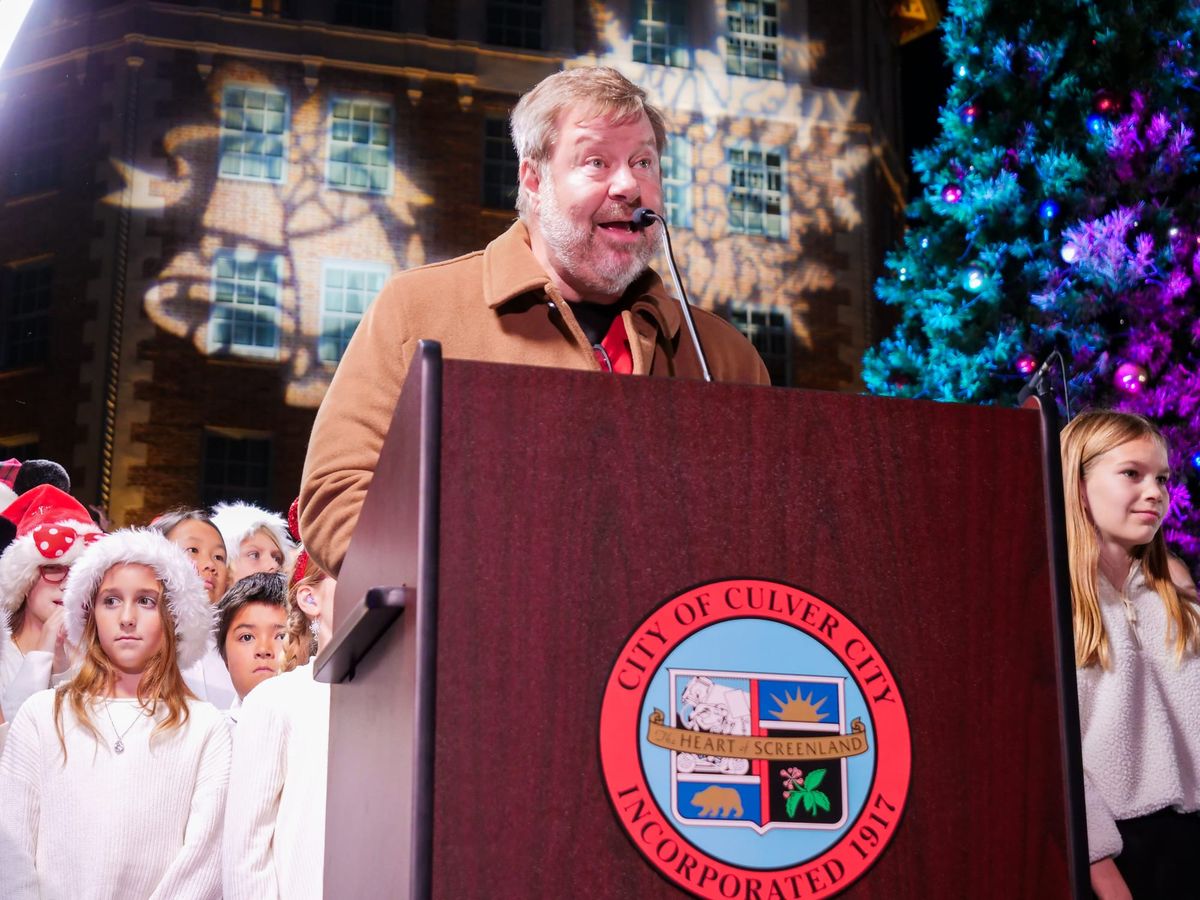
Culver City Unified School District Board of Education Candidate Darrel Menthe sat down with Culver Crescent Publisher Christian May-Suzuki to discuss his policies and positions for voters ahead of the 2026 General Election
The 2026 Culver Crescent Candidate Series is a key feature of our Voters’ Guide for Culver City residents for the November 3, 2026 General Election. As part of this series, candidates running for public office in Culver City sat down with Culver Crescent Publisher Christian May-Suzuki to share their thoughts and positions on the issues on residents' minds.
An edited transcript of these roughly one-hour interviews appears below. The length of these interviews was intentional, allowing candidates to contextualize their points and positions for residents less familiar with the scope of questions facing Culver City and CCUSD. For those more familiar with Culver City politics, key points and positions are highlighted throughout the transcript.
Darrel Menthe, Parent/Attorney
If you want to see some change come to the schools, if you want to see improvement happen, we need to put new blood on the school board; we need people who have the experience in law and management to do the things we really need to do to ensure the financial stability of the schools for the years to come.
Biography
Occupation
- Attorney and Executive Director of Culver City Downtown Business Association
Hometown
- Windsor, CT
Time Living in Culver City
- 19 years
Why You Came to Culver City
The sense of community and the schools.
CCUSD Involvement
- Two kids attended CCUSD Schools
- Served on Measure E Citizens Bond Oversight Committee (CBOC)
- Serves on Local Control Accountability Plan (LCAP) Committee
City Involvement
- 5 years on City Finance Advisory Committee
- 4 years as Planning Commissioner
- VP and Treasurer of the Culver City Centennial Celebration 2014-2017
Notable Endorsements (Full List Here):
Culver City
- CCUSD Board Member Lindsay Carlson
- CCUSD Board Member Andrew Lachman
- Culver City Council Member Albert Vera Jr.
- Culver City Council Member Mayor Dan O’Brien
- Former CCUSD Board Member Anne Allaire
- Former CCUSD Board Member Marla Wolkowitz
- Former CCUSD Board Member Scott Zeidman
- Former Culver City Mayor Ed Wolkowitz
- Former CCUSD Association of Classified Employees President Debbie Hamme
- Culver City Federation of Teachers, AFT Local 1343
- Culver City Democrats United
Los Angeles
- Los Angeles City Attorney Hydee Feldstein Soto
- West Basin Municipal Water District Board Member Scott Houston
- Former Los Angeles City Controller Rick Tuttle
- City of Los Angeles Fire Commissioner Jimmie Woods-Gray
- Heart of L.A. Democratic Club
California
- California State Treasurer Fiona Ma
- Irvine USD Board Member Katie McEwen
- Democratic Municipal Officials
One Thing You Wish More People Knew About You
I've been a committed and passionate Democrat since I was 14 years old, volunteered on a presidential campaign, but had to explain sheepishly that I was too young to move to Iowa. In college, I ran the UCSD Democrats for three years, just at the time when California was transitioning from Reagan/Nixon Country to a solid Blue state.
Favorite Thing to Do in Culver City
Late night drinks at Piccalilli.
Campaign Website
Opening Statement
My name is Darrel Menthe, and I always like to introduce myself by talking about what I'm proudest of in this district, and that's that I've had two kids who have gone all the way through CCUSD: one starting at the Office of Child Development, one starting in kindergarten. One of them just graduated and is going to college next week. The other is in 10th grade, so I've had firsthand experience with many of the schools for more than 15 years.
I'm a lawyer by trade, and I usually manage the Culver City Downtown Business Improvement District as my day job. I serve on the Planning Commission; I chaired it until a couple of months ago. I serve on the Oversight Committee for Measure E. I serve on the Local Control Accountability Plan (LCAP) committee for the schools, which determines how we drill down into the data and use information for disadvantaged groups or underserved populations.
Why am I running? I often like to say: think of the top 10 high schools in Los Angeles County, and if you didn't think about Culver City High, and I bet you didn't, that's why I'm running, because Culver City should be in the top 10 percent, top 10 of all high schools, of all districts in Los Angeles County. We can do that. We have all the parts we need to put it together, but we haven't yet.
We've been in a slow-running financial crisis for the last several years. We misspent one-time COVID funds that we expected would somehow last forever. When we had the opportunity in 2024 to address that situation by putting another tax on the ballot, we didn't. All the school board did was renew the existing tax.
Things got so bad last year that I was among many parents and school board members who went to city council and basically begged for money, and we got $2.5 million. It helped, but that's not how you run a district. Layoffs have gotten deep this year. They've hit the arts and other things that we really care about.
We need change, and the pitch that I give everybody is "Three incumbents are running, and I'm the challenger. If you want nothing at all to change, by all means, reelect all three incumbents, and you can have your wish.”
You already know who they are and what they're going to do, because they've been doing it for the last four years.
If you want to see some change come to the schools, if you want to see improvement happen, we need to put new blood on the school board; we need people who have the experience in law and management to do the things we really need to do to ensure the financial stability of the schools for the years to come.
On the Parcel Tax and Increasing Revenue in CCUSD

I absolutely believe the parcel tax is an ideal way to raise funds for CCUSD. I spearheaded this effort. I drafted the text, negotiated it with the city attorney, and worked closely with a group of parents to get it on the ballot.
We got over 4,200 signatures in less than 100 days, and it's the first time in this century, and probably in Culver City's history, that anyone has gotten an initiative on the ballot with only volunteer effort.
We did this because we really have only two options as a district. The district can't raise fees on students, and we don't have other taxing mechanisms. The only taxing mechanism available is the parcel tax. So, in a sense, it's that or nothing.
A flat tax is the most regressive kind of tax, so we took the current parcel tax, a $189-per-parcel flat tax, and looked for a better alternative. Berkeley and Alameda have been pioneering this, and it's a tax per square foot of the building, not per square foot of the property.
That means larger buildings pay more; for the first time in Culver City history, we'll see movie studios and commercial landlords paying their fair share to support the schools, which supports property values for all of us.
What I don't want to see are more cuts, because cuts at the school district mean cuts to labor. About 90% to 95% of all district spending is on labor, so when you talk about budget cuts, you're talking about laying people off. There are things you can do short of that, but if you ask teachers what they have, you'll find they lack all kinds of materials.
There isn't much extra in the CCUSD budget; it's very lean. The Culver City budget is three times as big, and has plenty of places where things could be trimmed to free up a few $1,000 here and there. The school budget did that stuff 15, 20 years ago.
It's a very difficult budget, and every parent who's ever been frustrated about something not being cleaned or the IT not being taken care of is frustrated because we're understaffed. This is the way forward, and a parcel tax like this is an investment in our kids. If you're a homeowner, it’s an investment in your own property.
The reward will be a significant increase in your property value, and that's why I'm behind this.
On Creating New Positions or Bringing Positions Back
When we drafted the parcel tax, I included specific language to do two things because, while we knew these cuts hadn't taken place yet, we knew some things had already been on the chopping block the year before.
The first thing we discussed was instructional aides in elementary schools. That includes reading specialists and math specialists. Those positions are proven to increase student test scores, and that effect lasts through high school.
Almost any teacher you talk to will tell you that early intervention in elementary school is needed to get higher-performing students and better outcomes as we get through high school. It's a little bit late if we have trouble with reading in 11th grade.
One thing we did in this parcel tax was create a robust, unique oversight mechanism. On all the committees that I serve on, they give you a list of expenditures after they spend the money, and your job is to see if it was legal. These bond measures usually say everything in the kitchen sink is legal, basically there's nothing to do.
In this case, parents from each school site, community members at large, representatives from both unions, and city representatives will be on this 15-person parcel tax committee. The city and union reps will, of course, be chosen by the city and the unions. The rest will be chosen randomly after people apply, so the school district can't put its buddies on this planning committee.
The planning oversight committee will have the funds and the charge to draw up a plan for the money before the school district does its budget. The school board must either follow that plan to the letter or explain in writing why it did not accept the committee's plan, so it's not entirely the school board's choice.
The community will be involved in how this money gets spent. Personally, I hope that we see an increase in mental health counselors again. We also need to make sure we're handling our arts program appropriately.
I know they've created a new position that encompasses much of the old district arts coordinator position. We need to see how that plays out. We don't want to keep adding administrators for the sake of adding administrators, because each administrator's carrying cost is about $300,000, while a teacher's is about $100,000.
More teacher time per student is the most valuable and effective resource we have in the district.
On the State of Mental Health Services in the District
Taking a step back, the state of California doesn't require school districts to provide for the mental health of their students any more than it requires them to provide for the physical health of their students (medical), and that always causes a problem because it means the state doesn't fund us to do it.
The state requires you to have a history program. The state requires a physical education program, but when it doesn't require something, it doesn't fund it specifically.
We do this as a district because it's really important to us as parents and as a community. I will tell you that I'm convinced that we do not have the support that we need right now for mental health. I don't think we did before, either.
When I was a graduate student at UCLA and a teaching assistant, I was not a mental health counselor. Still, I became one because my students would come to me and ask me about everything. The problem is if you don't have mental health counselors, every adult becomes a mental health counselor, and this is what is going to happen.
Everybody's favorite staffer will get asked these questions, which they don't necessarily have the training to handle, and certainly not the time.
We essentially need to double the workforce we already have. Parcel tax funds will make that possible. I will also tell you that in the parcel tax, only two things are forbidden, and one is using this new tax money to hire outside contractors when unionized staff could do the work.
We had a problem with that with New Earth, outside mental health counselors we retained when unionized staff could have done that work. The one thing that we can't do is repeat that.
On the State of Diversity, Equity, and Inclusion in the District
CCUSD is one of the most diverse public school districts in the country, and it's even more diverse than statistics would let on because most of the districts that seem more diverse, like Cambridge in Massachusetts, or Berkeley, are actually districts where the diversity is because you have different professors who have different ethnic backgrounds.
Here in Culver City, we have genuine socioeconomic, racial, ethnic, and religious diversity. This is what makes diversity one of the jewels of the district. It's what makes this district so amazing; you have black students, Latino students, Asian students, mixed-race students, LGBT students all here. They're all here openly and in significant enough groups so that they feel like they, I think that they feel like they really belong, or at least can feel like they really belong.
DEI is not just a value; it's a mandate for every employee in our district, period. It's a foundation for all our policies. Many board members talk about it regularly. The community wants it, and board members' job is to reflect the community's desires and needs for public schools.
Unfortunately, the Assistant Superintendent of DEI was a bad use of money to accomplish these goals. After that person was retained in 2022, I participated with the superintendent in a complete review of the district's organizational structure.
One of these was shocking: she had no direct reports; literally, she had no portfolio. She was just sort of an extra person sitting there sucking up almost half a million dollars a year between her and her one staff member, with no obvious ability to provide any services to the district.
I don't think anyone would tell you the district's attitude toward DEI has changed significantly since we eliminated that position.
But if we still had that position, we'd have zero mental health counselors right now because that would cost all that money. Do we have more work to do? We do, but I do want to say this.
We watch The Simpsons at home sometimes, and the first time we watched it with the kids, they saw these schoolyard bully characters and were baffled. They didn't understand what it was referring to. They simply had never seen a bully like this. They didn't get it.
For a kid like me who grew up in the 80s, that was my life. It wasn't only fascinating; it also shows what CCUSD does. This is the one area where I don't think we need to talk a lot about improvement. The kindness that these kids grow up with, their general willingness to include one another, is extraordinary.
Every year in Downtown Culver City, we host an event I created with staff, Culver City Senior Day, where we invite all graduating seniors to come. We put up individual pennants with each of their names, and if they find theirs and show us, they get a wristband and can go to various participating businesses for free items throughout the afternoon.
It's a wonderful day; these young people, now 18, come in these lovely multiracial groups. They're not coming as a clump of Latino students or a clump of Black students. It's marvelous to see, and for someone like me, who grew up in a very different era and place, it's extraordinary how well we do that here.
We obviously have more to do with the Trump administration around. We need to make sure we're prioritizing DEI efforts for that. But overall, that's not a lot of the additional work needed right now.
On the State of Attendance
Attendance has been increasing significantly. I'm on the LCAP committee, where we get the latest data. We review what's going on, and I think we are above average for the school district.
For the state as a school district, that's been going in a really good direction. At a certain point, you reach a cap on what you can realistically get, because there will be one reason or another why it's difficult to reach full attendance.
We want to do better, but the most obvious and pressing problem is that it's hard to physically get to CCUSD schools. We don't have buses, so parents drop the kids off, and especially if the parents are out of district, if there's a work conflict, if there's something else going on, there are reasons why there might be a day here, a day there, why someone doesn't get to school.
Once you miss one day, you come in, you feel a little bit out of it. If you miss a second day, you feel a little bit further behind, and it tends to build on itself. One of the things we need to look at is transportation. We obviously can't afford a fleet of school buses, but in the Fox Hills neighborhood especially, we have only one bus that can hold around 35 kids. It's not really sufficient.
We have the same problem with extracurriculars, and this is vital because, for many kids, extracurriculars are what makes them want to go to school. It's the sport they play or the club they're part of that gets them to want to come to school with their friends.
If they don't have the money to be involved in those extracurriculars, it's a barrier. If their parents can't drive them, or if they can't do those extracurriculars, they are less likely to show up, or to show up on time. Their attendance issues will be higher.
But the other problem is we also don't know because we haven't spent the time asking people, “Why are you not coming?” We actually haven't had the resources to have dedicated people literally call up parents and say, "What's going on?” School districts used to be able to do that 30+ years ago, when staffing levels were higher.
Another thing we can look at is whether we can have someone whose job is to be the person who follows up.
On the State of Facilities and Priorities for Improvements
When Measure E was put on the ballot, I was there with Culver City Federation of Teachers President Ray Long, and we both thought it shouldn't have gone on the March 2024 ballot.
It should have gone on in November of 2024, and we should have spent six months going from school site to school site to figure out what to do first. That didn't happen; it was rushed onto the ballot.
The school bond amount was simply the maximum allowed by law; all we did was say, "Let's give us the max possible right now, without any planning.” We then had to figure out what to do. We delayed all our plans by almost a year because we had to go school by school and ask teachers, parents, and administrators what they wanted.
That process wasn't as public or as involved as it would have been if we had done this before a vote. Part of the problem, and part of the answer to that, is we don't actually know what the public wants because we haven't really asked the public.
As representatives of the public, it's the school board's job not just to have its own ideas, but to listen to constituents and put those things forward.
What I would have liked to see is significant rebuilding of the high school and the middle school. Both are aging infrastructure. The elementary schools are older too, but the facility needs are lower because children spend their time in a single classroom. The number of parents who send their kids to the local elementary school is very high, and then drops off dramatically for middle school and high school.
I believe we need a swimming pool for two reasons. First, we need to be able to compete in aquatic events. It's important, but also every student at Culver City Unified should learn how to swim. This is a safety thing. It's sort of insane to be here in Southern California, with beaches all around us, and not teach swimming as a survival skill.
The one thing we do right is we have the Robert Frost Auditorium. The Frost is a beautiful building. We always put the Frost out publicly, and I want everything in the school to look as good to the public as the Frost does. It should have that level of service.
On Supporting Teachers in the Classroom
This is my number one priority for the parcel tax, and frankly, an easy one. The actual dollars that each teacher needs are relatively small; we're not talking $10,000 more for supplies per teacher or anything in that range. A couple of $1,000 each would cover most of the needs. This is a $500,000 or $600,000 kind of expense. It's the sort of thing we should be able to do.
Incidentally, it's the same size as the administrative position we eliminated a few years ago; these are the trade-offs we need to make. It's about dollars and cents, but it's also about dignity. Nobody wants to do a job without adequate tools. It eats away at morale, and I have a real problem with that.
I said earlier that teacher time per student is the most valuable thing we have, but our most valuable resource is our veteran teachers who have been here for 20 or 30 years and know what they're doing. They're the backbone of the school. They socialize younger teachers into what's expected of them, and parents have gone to them for years.
What I want to be is a district where, when our teachers go to a conference, and someone says, "Oh, where are you from?” and you reply "Culver City," they respond, "Ooh, that's great,” because they've heard how good the support is for the teachers.
What's frustrating is that there's a relatively small dollar value needed to make a lot of those changes. We haven't done that because, as I mentioned earlier in this process, we've had to squeeze everything out of the budget just to survive, and we need to get past that.
On Honors Courses and Roles in Curriculum Development
I've been a strong proponent of restoring Honors classes and making sure we not only restore them, but also have an honors and accelerated curriculum available to every student at the high school, and, where appropriate, at the middle school.
We used to have that as well, and this is not some radical curriculum position. There are 10,000 high schools in America, and of those, the number without an honors class is small enough to count on your fingers. There are probably fewer than 10. It is an extraordinarily rare thing to do.
When parents look around a district and see that it doesn't have what every other high school has, and that what it lacks is academic, they start to think, "Is this the place for my kid?” Parents in this district send their children to El Segundo, Venice High, and Hamilton High. They're not just wealthy parents taking their kids to private school.
They are parents who couldn't afford private school who are crossing the border to take their kids to LAUSD, El Segundo, Mira Costa, wherever they can go, because those places offer what is considered a standard set of curriculum.
We cannot fall below that standard. It is literally costing us Average Daily Attendance, which costs us money. We're probably losing teachers and certainly losing parent members in the community.

An elected school board is supposed to make broad curriculum decisions, and this is a broad curriculum decision. I realize a number of English teachers felt differently, but one problem is that it simply didn't work. It was sold to us as if eliminating Honors English in ninth and 10th grade would increase Black students' enrollment in AP classes, especially AP Language and Literature.
It did the opposite. We saw a significant drop, and in the first year, Black students' test scores were 38 points lower than before.
That is a catastrophe. That is when you immediately back up and say, we cannot have that because this is a diverse school district. Our duty to look at every ethnic and racial group to make sure they are all performing is absolutely our number one priority. When you see that with Black students, who are already an underserved population, we need to turn that around.
I'm sorry that the discussion got heated, but parents get heated. They care about their kids. They care about this district's future. I am the only candidate here who's committed to restoring Honors 9, period. I'm the only candidate committed to looking at honors classes across the board, and I think almost every parent in this district wants to see that.
This is not about tracking or detracking. Nobody's being tracked in these classes. Oddly, tracking happens when everyone has to go down the same path, and there's a one-size-fits-all class. These classes are options, and if we're not seeing the racial diversity we want, our school counselors and our teachers need to think about how we can do better.
Of course, they need more resources. We need more of them because we need more people out there who can see, individually, which students would benefit from an advanced curriculum and encourage them to take it.
On Arts, Career Technical Education (CTE), and Electives
I've had two kids deeply involved in the arts throughout their time in CCUSD. My daughter was the co-concert mistress of the Orchestra in her final year, and one of the presidents of the Academy of Visual and Performing Arts (AVPA) Music.
My son is in his second year with the marching band color guard. He plays the cello and is learning the tuba; he just got a lyre and an ocarina; it's like a menagerie of weird instruments at home now.
I point this out because the arts are extraordinary here. My kids have both participated in AVPA. I like to think of myself as a band dad, so I'm really committed to these programs. I've seen how great they are, and as I referenced in an earlier answer, these extracurricular programs often help kids focus on being in school because that is where they build their social network.
This is where they get their self-esteem from, and this is what really helps them, so we have to do this.
As far as electives and CTE, it is worth noting that CTE is supposed to be a pathway. In a sense, it often substitutes for classes for students who aren't going to college. What's happened with many of these classes is that they've essentially become electives, and I know that because my son takes them as electives rather than as a pathway, which is fine.
But we need to be aware that they're electives for many kids, and they're not really part of a pathway for those kids even though they get funded primarily as part of a pathway. The state grades us on who “finishes or doesn't finish” these pathways, and the state will often say we are failing because we're not finishing with these kids. Well, they're not trying; they're taking them as electives.
What's my hope for the new arts coordinator position? We have one high school, we have one middle school, so the coordination that needs to be done is not really between schools, which is what would happen in a larger district.
Making it a larger role is an interesting idea. The real goal is to make sure that we're getting resources directed by this position. So I would say that what I want to see is a lot more grant writing.
I know the prior occupant of this position did a lot of grant writing, but that wasn't a primary charge, and I'm not sure there was specific training for it. If we make grant writing a big part of this, a quarter of a million dollars makes a big difference, and there are millions of dollars out there.
On Outside Contractors
It's important to remember what New Earth did and why this was so problematic for us. New Earth got this contract, but it was more of a letter of intent with large dollar values. At some point, it was decided, and a couple of school board members appear to have helped, to use New Earth to send threatening letters to community members viewed as political enemies of certain school board members.
That included Lindsay Carlson, who ran for school board and now sits on it. When parents confronted the school board and said, "Why are we getting these cease and desist letters for apparently speaking out on social media, or in Lindsay Carlson's case for doing nothing at all?” one of the school board members actually apologized to New Earth that this was being brought up. The other school board members, the ones I'm running against here, sat there, watched, and did nothing.
That's why this was really controversial. This was a vendor, and when a vendor sends threatening letters to the community, you terminate them immediately, without question. New Earth then sued the district for hundreds of thousands of dollars for work they didn't perform, saying they expected to profit off the district. That case was just dismissed, thankfully.
That lawsuit cost the district at least $200,000 in attorney fees. How did we get there? This is about choosing one's friends and one's political affiliations. This was a political choice that certain people made.
We need a pledge not to make vendor choices on political grounds, and we need to see two things. One of them is campaign contribution limits. There are no campaign contribution limits for school board races. Campaign contribution limits can exist only if the school board demands them and puts them on the ballot. I will demand that.

I will also demand term limits for the school board, because we don't have those either, and that has to be done by referendum.
I'm the only candidate even talking about these things, by the way. I want to see both of those because we have seen outside interests give well over $1,000, $2,000, $5,000 to candidates in this race and in prior races, and we don't want to see that going forward.
At the very least, we should have the same rules that apply to city council, including the same term rules.
On Mobility and Transportation To and From CCUSD Schools
When I looked at the Tri-School Area proposals, I sent out a whole bunch of notes, and most of those notes were: “Have any of you ever talked to a parent or a student?” The problem is that everything goes the wrong way.
One of the big proposals was: Should we put a bike lane on Elenda? Elenda runs parallel to the school for the most part, and very few students actually bike down it; they go east-west down Farragut or come up from Lindbergh Park. I understand certain activists wanted the bike lane connectivity for other reasons, but it wasn't specific to the schools.
At one point, they were also advocating having students go through the Harter Avenue gate to the school. And I said, "Well, you all realize there's going to be a construction project there for the next two years?” Did anybody look at the Measure E plans? No, they did not.
It was just a poorly put-together process. Parents need to be driving this process. We need community members and nearby residents involved because they know their streets and live there. Parents need to be involved. We also need teachers to be involved in this process.
Unfortunately, the city has conducted this process, and it has a different set of constituents. The city's relationship with the district is just very thin on the ground, and even thinner at the staff level. We really need to make it much easier for students to bike and walk to the schools; that's how both my kids get there. They've been doing it since middle school.
They don't take the bike path down Ballona Creek because it's frequently blocked, and the elevations are a problem. I got really concerned because one of the unhoused people in an encampment actually accosted my son when he was about 11 years old while biking through there. My son was okay, but I didn't like hearing about that, so they take Farragut all the time.
On Attracting Culver City Families to CCUSD Schools
Are we having trouble attracting and retaining students? We are having trouble. I referenced this earlier with respect to the honors classes. Some parents have kids who want to play water polo, but they have to use The Plunge. We've had to move leagues because some schools don't want to play with CCUSD because our facilities are inadequate, and parents see that; if they can afford private school, they go elsewhere.
I know many parents who moved out of the district. They were in elementary school, but they moved out of the district because they couldn't afford to be here. If they wanted to keep sending their kids to school with their friends, why wouldn't we want that?
We have students, staff, and teachers who want to be here. We also have companies like Apple and Amazon and Time Warner and TikTok that are here, and their employees sometimes want to send their kids to Culver City Unified. That is something that we also want to see.
We've also had students from Inglewood come over because the state took over Inglewood because they didn't get their finances in order, which is a warning that could happen to us if we don't get our finances in order. Parents in Inglewood who were savvier and understood what was going on let their students move to Culver City Unified because they felt it was a better experience than the state-run schools left in Inglewood.
We don't want overcrowded schools, but we also need to remember that a certain student body size is actually important to having the diversity of class offerings that we want. I want to see more class offerings. I want to see more foreign languages being taught. I want to see more of the electives we referenced earlier, whether it's the video game design, music, or arts.
But if you have fewer students, you have fewer teachers.
That is literally what happens when you get paid per pupil. The more students we have at a certain level, there's sort of an ideal level, and we've been fairly consistent at about 2,000 students in the high school, and essentially that's about 500 students per grade level across the district. We've been fairly consistent for many years; some bring diversity to the district from outside, but we also have a very diverse district of residents.
What I like to tell people is that these are all our students. We are all their parents, whether or not you have any kids in the school.
On Recent Administrative Turnover
To a certain extent, when everything happens at once, it's just coincidence. But as a district, we are a place where a lot of people get their first administrative job. It's considered a plum position for that.
Superintendent Brian Lucas had not been a superintendent before; this was his first superintendent job. Our current superintendent, Alfonso Jiménez, is the first superintendent we've ever had with actual superintendent experience in some time.
For a lot of our assistant superintendents, this is their first job where they have that title, and so then what they do is they take that title and then shop it elsewhere and get a better job for their own career track.
Why do they do that? It's because they're unhappy at CCUSD sometimes. Sometimes it's personal, but sometimes it's also about compensation. These are fairly highly compensated people, $200,000+. They're not poorly compensated, and many parents earn less than that and think, "Why should we pay them more?”
Unfortunately, the market is what it is. You lose people because they get paid more elsewhere. Of those who left this year, all of them were paid more elsewhere. You cannot retain your best staff if they can get lured away by higher, higher salaries elsewhere.
One thing Superintendent Jiménez has been able to do is retain top-quality staff, but that will be difficult if we don't have the resources to pay them more. One of the things we're going to have to do is increase administration compensation.
I'm sure they also understand, at a basic level, that it's true, and the actual dollars and cents involved aren't that huge, but it does mean we don't need many new administrative positions to do the work.
What we need to do is make sure that we are taking the ones that we have and really working with them and saying, “We want you to be here for five or 10 years.” That's going to be on the compensation side. Again, that's a challenge because I don't like paying more for administrative salaries. But we have to do it.
We're going to have to do that because that is ultimately why people are leaving. I don't think the district solves a problem, but we need to avoid being a stopover. I'm actually very pleased that our new Education Services Director — I believe she was at LACOE — has moved over. She has a great background, and I think she may be a keeper for a while.
We also want to make sure when we're interviewing people that we're talking about their long-term future. We had an interim briefly after Lucas left, named Keller, who had been in Redondo for 30 years, I believe. Thirty years is a long tenure for a first-time superintendent. Maybe that's too long, but we need someone who wants to make it their career and will be personally invested.
We also need to look down at a principal level. We've had a lot of turnover at the principal level. Part of that's going to be compensation, but part of that also is that this is a district structural problem. We have one high school and one middle school. So what is the district doing? I say that because in other districts you have multiple high schools where the district's job is to take resources and coordinate between high schools.
Part of what happens is that our administrators at the district level can sort of squash the principals because what work belongs to the principal, what belongs to the administrator, superintendents above them, and I think they need to be more intentional about making sure that the principals have whatever autonomy they need, and also the resources they need.
On Balancing Fiscal Responsibility with Goals
There are so many great ways to address this question. Superintendent Jiménez shared a graphic earlier this year that upset many people because it listed things as either necessary or nice to have, and it put the arts in the “nice-to-have” category, which made a lot of people freak out.
From a values perspective, I understand the arts are absolutely essential from a moral perspective, but I think the superintendent's point was that the state requires us to do certain things. It doesn't require us to have AVPA, so what do we do if we are down to our last dollar? We'll have to cut the programs we love because the state won't let us cut the other things. We can't just decide we don't want history. We can't just decide we don't want a gym.
I think it was useful to put that out to the public so people understand these are the choices that have to be made, and when we have to make those choices, we're going to end up cutting the arts and athletic programs we really care about.

We were also already cutting back on what's called TOSAs, teachers on special assignment, the reading and math specialists at elementary schools. I referenced earlier how vital I think those roles are, and I just want to circle back on how vital that is.
We've seen decreases in test scores. There was a bump up this last year; I haven't seen that data yet because that data has been released to the superintendent and the school board, but not yet to the public. But it follows several years of declines, and sort of the overall trend has not been where we want it to be.
We also had a problem when we came to our layoffs. In March, we have a layoff list, and the public sees it with 72 hours' notice. Is the public expected to go through the personnel reports to figure out who else to fire?
The question is, how does the board get this information earlier so it can be involved in that decision? My understanding is that the board was actually aware of the number of cuts and the number of people going to be cut some months earlier than the public was. I'm not sure about how all that was done, but I believe they were aware, so there's been a presentation that just sort of came up in the market for the public.
There wasn't an ability to sit down in October and November and December and say, okay, what is our budget looking like for the next fiscal year? If we have to cut things, what will we have to cut? What else can we do now to avoid those cuts? And what are you, Mr. Superintendent, Madam Superintendent, looking at to do?
It is not a board member's job to go through the personnel reports and say, “Yes, I like you,” or “No, I don't like you.” It's almost inappropriate to do what we had to do, which is say, “We'd like to keep three mental health counselors” and this and that.
That level of micromanagement is something we really shouldn't have to do as a school board, because it puts it in the position of making individual decisions that are essentially programmatic, and those programmatic decisions should come from our superintendent.
But there was no real choice unless we wanted to face the possibility of LACOE takeover.
I want to sit down with Deo Persaud, our new chief budgeting officer, and the superintendent to talk about how we redesign this process so we get much earlier input. I know the state gives us certain rules; one is that you have to give layoff notices by a certain date, and if you don't, which is in March, you can't lay people off for the next year.
Part of the problem with that, just from a cycle point of view, is that you have to decide by law in March who you might lay off, even though you won't know until June what your budget looks like. So part of what happens, as happened the last three years, is that we decide we have to pink slip people, even though we might not have to lay them off.
From an administrative point of view, this is an annoyance. From a teacher's point of view, this is a catastrophe, because just imagine getting that layoff notice as a teacher, and then being told, “well, we might not have to do it.”
At the very least, we've signaled that we don't think you're valuable. This is a vital issue because we end up making decisions we don't want to make, and we get boxed in because we couldn't make decisions earlier.
On the budgeting side, people couldn't give the school members information early enough, and Santha Rajiv, who was here last year, took tremendous strides forward.
I know one of the things that she was able to do was also find money in other places. We put in place this new Facilitron system, which everybody hates. I just say that off the top. Everybody hates it because you have to reserve things in advance, but it costs money. We're charging money to community members. There are lots of reasons to hate the system.
On the other hand, I believe it brought in a little more than $400,000 last year, which is three or four teachers. Those are mental health counselors we didn't have to let go. The parcel tax is one of the few mechanisms for raising money, but one of the only other ways we can raise money is charging fees for rooms, essentially as a landowner.
We need to get involved much earlier in that process, and we also need people on the school board who understand finances and management. Experience with schools matters, but just because someone's a pilot doesn't mean they know how to run an airline. These are different skill sets, and the primary job of an elected representative is to make sure that the district has the resources it needs to be financially stable.
The second, related job is to ensure the community's interests, goals, and values are reflected in public schools, and that's what elected board members bring to the job.
On How He Hopes His Tenure Will Be Remembered
I'm going to start with a little bit of a joke. You may know why Linwood E. Howe Elementary is called Linwood-Howe Elementary; it's because Mr. Linwood E. Howe was the principal when they rebuilt the school, and he died. I would prefer not to have my name on a building because I died while on the school board.
It's a small point, but it actually leads into a larger one. The job is not about us as school board members. A good school board member does not get remembered especially well in the district.
I think what I'd like to know is that, assuming I'm elected and assuming I serve eight years with term limits because I want to see term limits, people say to me, "Oh, are you still on the school board,” or still think I am, because they continue to associate my name, hopefully my good name, with what I would say is a real change in trajectory that we need in our schools.
I imagine it as an ocean liner that's gradually turning around, getting it to turn around. This is really complicated. Democratic Party officials asked me about my role with the unions and why that mattered to me, and I think they expected an answer about why unions are important to me.
Unions are important to me, in an emotional and political sense, but what I had to say was that most of our policies that we want to see changed have to involve teachers, and we cannot make big policy changes if we do not bring the teachers on board. They have to be part of it.
We have a new cell phone policy that's proving difficult to administer right now, and we're not sure what it's going to look like. As that policy evolves, we're going to have to make sure the teachers are involved because they're the ones on the front lines who have to figure out whose phones to take and who to discipline and how to make that work.
We are talking a lot about AI in schools right now, and what we are going to do about it. We can't have that without the teachers being involved. And notice that as I keep talking about that, the word "school board member" is not really that prominent because the school board member's job is to help formulate that policy. But you won't be remembered as the guy who banned AI.
Simple bans are a very crude tool, and hopefully we'll have a better outcome than that. We do this a lot in this city. We have people who like to call themselves progressives say, "Well, let's just ban this and ban that and ban this and ban that."
Yeah, just banning stuff is a set of tools that King Edward the First had. We can make smarter policy. We're going to have to make smarter policy, and as school districts, we're going to really need to think about what smarter policy looks like.
My hope is that 25 years from now, I'm still welcome at the school district, and maybe even able to go on up to the podium and talk about what things were like in the early part of the 21st century and how we managed to make some big changes.
Closing Statement
The number one and number two job of an elected representative is to make sure that you're representing the interests and values of the community. I like to be as blunt as possible in electoral situations, because there's time for slogans, and then there's time for just talking.
This election is about deciding whether to change, or to not change. We can reelect three out of five board members, and that's a majority. If we reelect three out of five board members, we won't see change.
I'm not saying these are not good people, but for the last three or four years, you've seen what these three incumbents are going to do, and they're going to continue to do that for good or ill. That is the path we're going to be on if we do not make change.
I believe most parents and the community here in Culver City want to see change. They want to see financial stability.
They also want to see a vision for the future, and the vision that I articulated a little bit earlier was that I started by saying, think of the top 10 high schools in Los Angeles County, and if you didn't think about Culver City High, that's why I'm running. For me, this is about a culture of excellence.
You may have heard that the way you do one thing is the way you do everything, and this is true of institutions as well. The way the school district serves one student is the way it serves all of its students. The way it maintains the bathrooms is the same as how it handles class scheduling, and when we do one thing badly, we do other things badly.
I want to create a culture of excellence: excellence in education, excellence in facilities maintenance, and excellence in budgeting.
At every place, I want people to be asking. How can we be the best? How can we reflect the excellence that is a core value of the district? One of the great things about something like creating a culture of excellence is that it spreads, and it sticks.
In many places in America, the high school is the most important building in a small town; people clean it with love, hold events there, and celebrate it because it is a cornerstone of the community. Culver City has been like that in the past. This is the vision we ought to have for the future: everybody in town is proud of our Culver City Centaurs.
One of the reasons that I created Culver City Senior Day in Downtown Culver City, is because I want the business owners downtown, many of whom don't live here, to connect with the high school. It's not just good from a business perspective, right? Because by the way, it is.
They should know their regulars come from here. These are our Centaurs, and I want them to feel that way, because when they feel connected to the community, the community feels connected to them.
It's good for the entire community and creates a positive cycle. This needs to happen in our public schools because I don't want to see parents taking their children across district lines or sending them to private school.
I didn't go to any private schools in my life until I went to Stanford Law School. There is nothing wrong with private schools, but I like what you get at a public school in terms of the values that it teaches, and I went all the way through. The first value it teaches is that you are a citizen in a democracy, and that everyone around you is your fellow citizen.
I think you learn this at a very basic level when you experience it, and I never thought about sending my children to a private school because I wanted the experience I had: feeling part of the community in a really deep way. I think that's where I got my values from, in many ways. Investing in public education is investing in democracy, so we need to make change in the school district.
I'm ready to serve, and I hope I'll earn your support.



Comments ()