
Dear Culver City: The Mystery of The Missing Students Solved
EDITOR'S NOTE: This piece was submitted by a source unaffiliated with Culver Crescent and does not confirm the opinion of The Crescent or its writers.
EDITOR'S NOTE: This piece was submitted by a source unaffiliated with Culver Crescent and does not confirm the opinion of The Crescent or its writers. Click here to view the full Dear Culver City disclaimer
By Darrel Menthe and Jeanne Black
In her opinion piece in Culver Crescent on May 19, 2026, Dr. Carolyn Libuser claims that between 1,054 and 1,604 students enrolled at CCUSD are neither Culver City residents nor attending on permit. The claim is these are missing students in the data.
To reach this conclusion, Dr. Libuser takes some existing population and enrollment data and applies certain assumptions. The purpose of this is not academic, but seems to be a pre-existing belief that there must be some explanation for the school’s financial crisis other than a lack of resources.
Occam’s razor, however, tells us that the simplest explanation that fits all the facts is most likely to be correct. With a better understanding of the data and more reasonable assumptions, the “missing” students disappear.
Let’s take a look at that data and its sources.
To determine the number of resident students who should be enrolled in CCUSD schools, Dr. Libuser begins with the census data, arguing that the number of 5-17 year olds is a good proxy for the number of children who should be in school. The population figure for children ages 5 through 17 is 5,494 in the 2024 population estimate. That figure is used as an absolute reference point.
There are two problems with treating this as an exact figure.
First of all, it is an estimate. The estimate comes with a margin of error of ± 1,470. In other words, the actual number is between 4,004 and 6,964. The data are from the American Community Survey (ACS) 5 year estimate for 2020-2024 produced by the U.S. Census Bureau.
Because the data are based on a survey, the Census Bureau provides a margin of error. These are always greater when small populations are surveyed. The Census Bureau urges caution when using estimates for which the error is greater than 10% of the population.
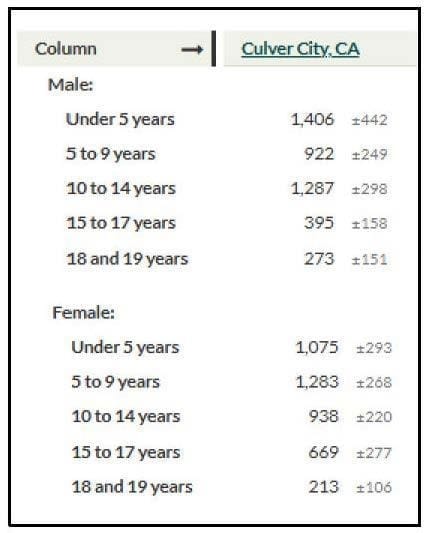
Note that the margin of error is large enough to account for almost all the allegedly missing students by itself.
Second, the 5 - 17 year old group is not a perfect proxy. Kindergarten is optional in California. Some 5 year olds are not enrolled in school. But Transitional Kindergarten (TK) is now available, so many 4 year olds are enrolled. 18 year olds also are enrolled as high school seniors. There are 6,589 enrolled students, according to CCUSD records. Every 1% change in that figure is ±65 students.
The actual number of school-age children in Culver City could be up to a thousand more or less than the 5,494 number Dr. Libuser uses, for several different unrelated reasons.
So instead of hard data, we have rather soft data.
The article also misstates the number of students on permit. Here, an estimate is inappropriate because we have actual data. As of October 1, 2025, there were 744 (elementary) + 980 (secondary) = 1,724 (not 1,382) students on permit. The number of resident students is 4,865. That is a permit rate of 26.2%.
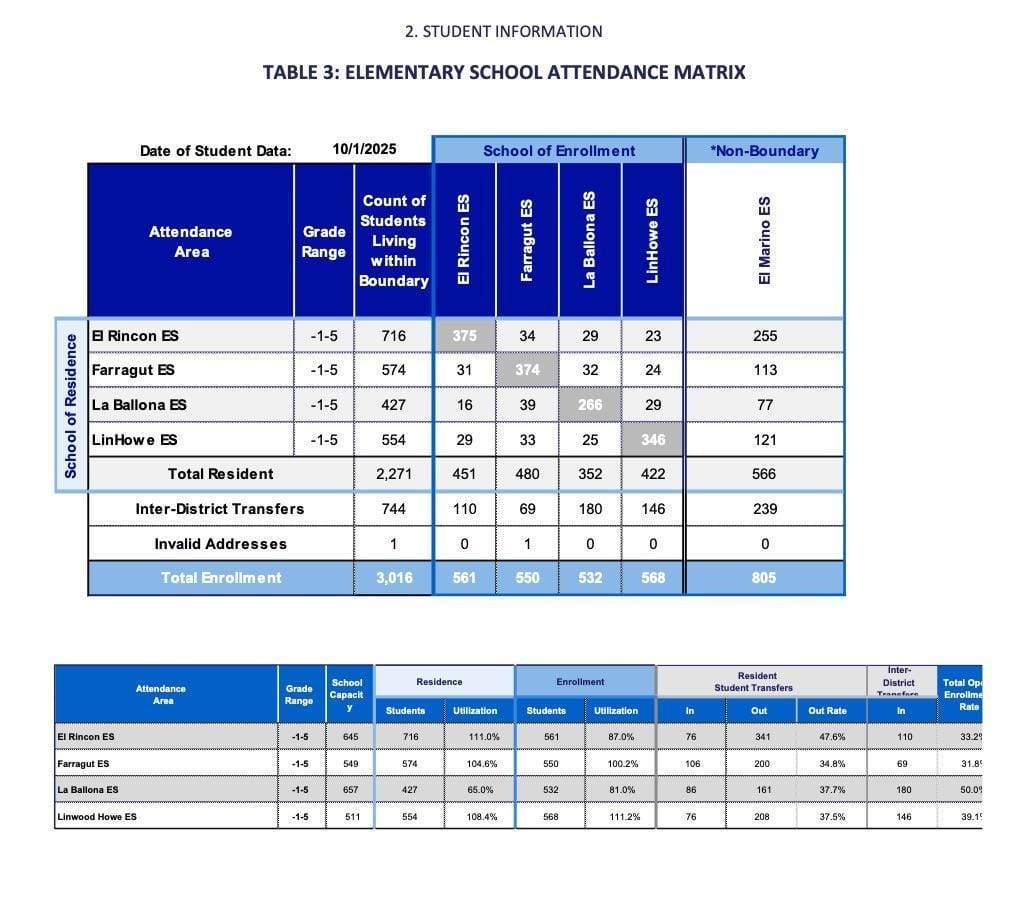
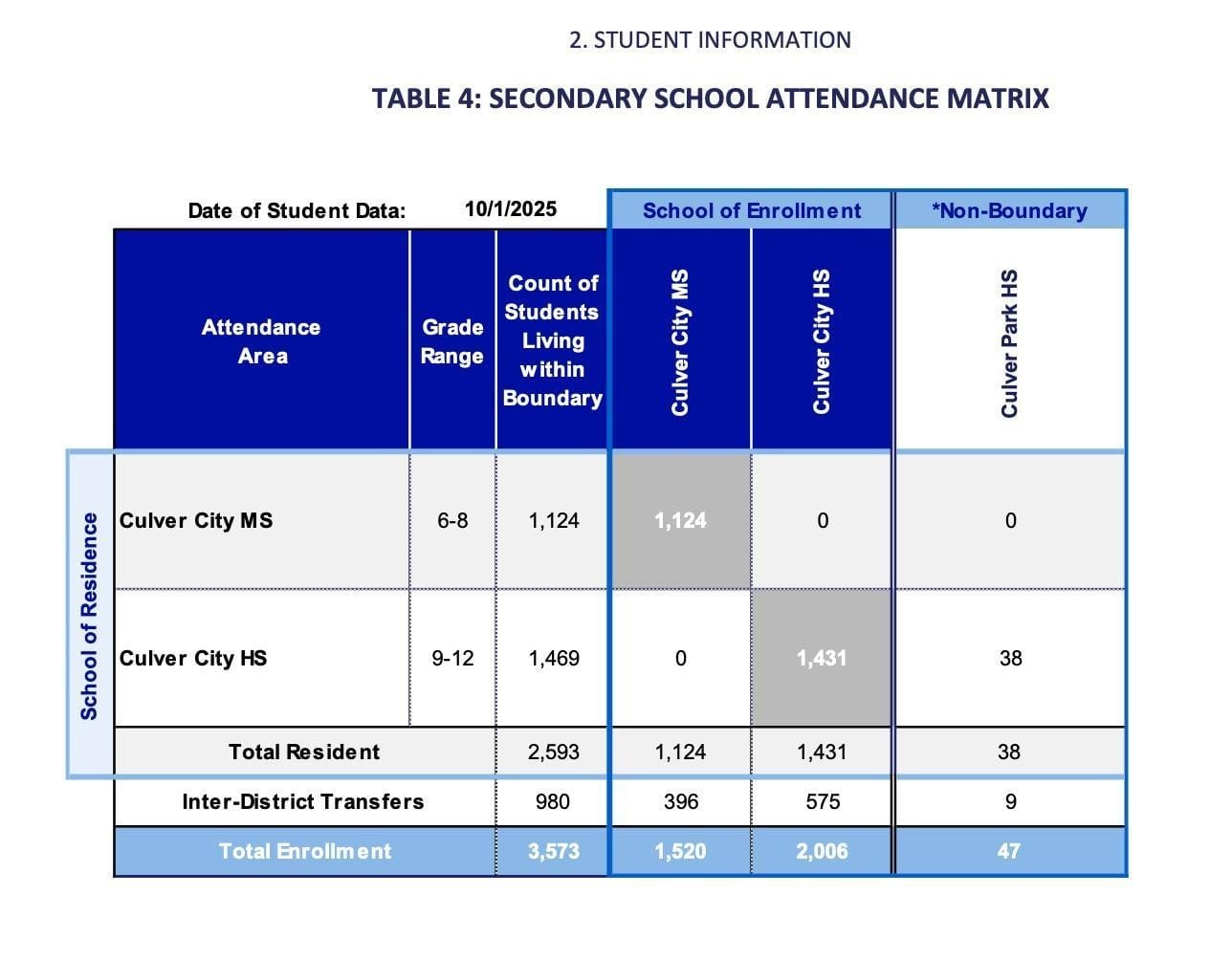
Those are the data issues. Then there are the assumptions.
In order to generate missing students, Dr. Libuser applies a percentage to the number of resident students to represent the proportion that actually enroll, that is, excluding those who are assumed to be private school diversions, students who transfer to public schools outside the district, and homeschooling.
For that, we do not have specific data; we have a conjecture. The assumption that a large percentage of resident children do not enroll in CCUSD schools is the mathematical device that creates a gap between expected number of resident children and the actual number of enrolled resident children.
What percentage of Culver City residents actually attend other districts or private schools? We do not know. Unlike the census data, Dr. Libuser cites no source here. She argues “based on data from neighboring districts, at most 70% of residents will actually enroll… Some say the enrollment rate could be as low as 60%, since many residents enroll in private schools.” We do not know where these percentages come from.
We can suggest a documented source for this key assumption. Since this all began with the census, we can go back to the same census data. The ACS also collects data on public and private school enrollment. The smallest local jurisdiction for which data are compiled is Los Angeles County. It shows estimated K-12 enrollment in public schools at 88.3%, with a margin of error of ± 0.7.
Is 88.3% the correct percentage to apply? There are reasons to think it is too high or too low. LAUSD comprises the majority of the LA County area, and we have at least some reason to believe parents in CCUSD are less likely to choose alternatives. At least, we know more students permit into CCUSD than out of district.
On the other hand, many LAUSD parents cannot afford private school and probably more Culver City residents can. At any rate, applying 88.3% is a reasonable place to start a data-driven analysis.
Here’s what is truly notable. Even without accounting for margins of error, applying the county-wide 88.3% enrollment percentage to the estimated 5,494 resident figure yields 4,851 expected resident students enrolled, essentially the same as the actual enrolled number of 4,865.
In other words, the entire conjecture about “missing students” is negated if we make different, more fact-based, assumptions about who is enrolling in CCUSD schools.
This is not a “hard data” story. It is a data selection and interpretation story.
What we really have is a range of census population estimates for school-age children in Culver City and a range of potential estimates of the percentage of school-age children who should be actually enrolled. You can apply estimates from the edges of those ranges to create a “missing students” mystery, but you can also choose many reasonable values within these ranges that line up well with the district’s reported numbers.
Following the principle that the simplest explanation that includes all the facts is likely to be the correct one, we should conclude that there are not a thousand or more “missing students” that nobody can find.
And if there are no “missing” students overburdening our school district, then discussions about limiting permit students or “rightsizing” the district by closing elementary schools are just distractions from the real issue: the chronic underfunding of K-12 education in California, especially in districts like Culver City Unified School District that have never had substantial local sources of revenue to add to state funding.
Darrel Menthe has two children at Culver City High School and has lived in Culver City for nearly 20 years. He currently manages the Culver City Downtown Business Improvement District, serves as the Chair of the Culver City Planning Commission and is a candidate for the Culver City Unified School District Board of Education in 2026. Menthe also volunteers on the CCUSD LCAP Community Partner Advisory Committee and the CCUSD Measure E Bond Oversight Committee and previously served on the Culver City Finance Advisory Committee.
Jeanne Black received a PhD in health policy & management from UCLA and an MBA from the Northwestern University Kellogg School of Management. She has lived in Culver City for 28 years. She is chair of the CCUSD Measure E Citizens' Bond Oversight Committee and a Culver City Planning Commissioner. Prior to her retirement, she was Associate Director for Health Policy and Program Evaluation at Cedars Sinai.


Comments ()