
Breaking down Culver City's Tri-School Area Mobility Concepts
The city debuted these concepts at a community workshop held last Wednesday to gather feedback from residents on what they would like to see from this project
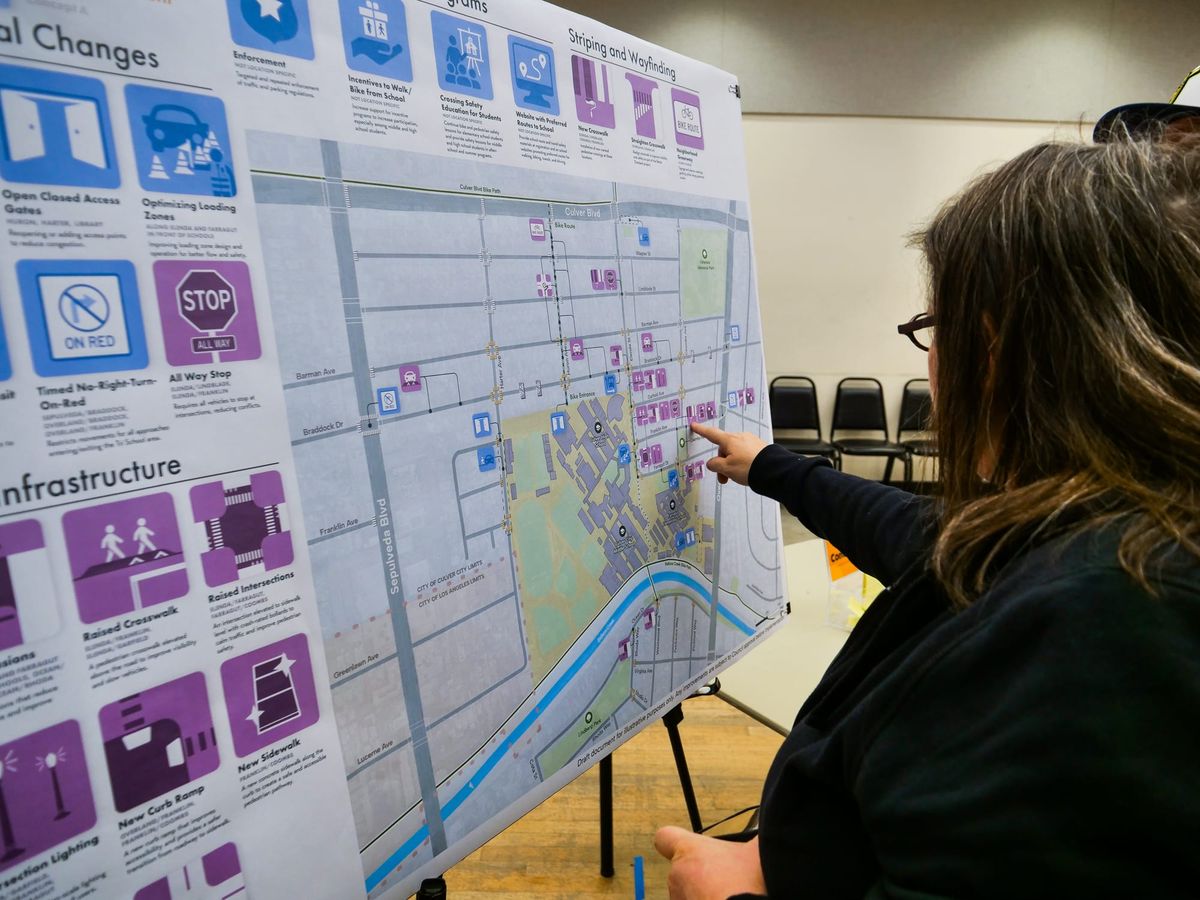
Culver City unveiled conceptual proposals stemming from the Tri-School Area Mobility Study, which is examining how to improve mobility in the area around Farragut Elementary School, Culver City Middle School (CCMS), and Culver City High School (CCHS), at a community workshop held last Wednesday, May 27.
Three concepts were presented in detail to the community last week at the Culver City Senior Center. These concepts — labeled A, B, and C — represent escalating investment in the area. While Concept A represents minimal changes that can be implemented without the city council's approval, Concepts B and C include significant infrastructure changes.
Part of the impetus behind Concept C was to explore the potential for installing a Class IV-protected bike lane on Elenda Street. However, due to concerns about impacts on the nearby parking stock and tree canopy, and a user volume that does not meet the minimum thresholds to justify such a facility, this idea was deemed infeasible.
The concept presented a bike lane similar to the one on Huron Avenue in Concept B, and the Elenda Street “Neighborhood Greenway” and its associated improvements are the only differences between Concepts B and C.
In addition to soliciting feedback on each concept and its components, the city also asked residents to vote on which concept was most appealing. Attendees of last week’s workshop were encouraged to vote for the concept that most appealed to them, and an option to vote “No Change” was also available.
There are 17 total classifications of improvements in the concepts. Each is described in the maps of the concepts in which they are implemented, as follows:
All-Way Stop Sign: All-Way Stop Signs are proposed to reduce traffic conflicts.
Curb Extensions: Extend the sidewalk to improve visibility and reduce walking distances.
Intersection Lighting: Pedestrian-scale lighting to improve visibility.
Neighborhood Greenway: A bike path with shallow markings and signage to guide cyclists on an ideal bike route.
New Crosswalk: Marked pedestrian crossings to establish paths of travel across streets.
New Curb Ramp: Helps ease the change in elevation from curbs to streets and improves accessibility.
New Designated Dropoff Area: Clearly marked spaces for loading and unloading students.
New Sidewalk: Only proposed on Franklin Avenue at Coombs Park as part of efforts to create a new accessible pathway.
Open Closed Access Gate: Opening several gates will improve student flow by increasing the number of access points. Subject to Culver City Unified School District Approval.
Optimize Loading Zone: Improving loading zone design and guided operations for a more efficient flow of traffic and students.
Raised Crosswalk: An elevated crosswalk meant to improve pedestrian visibility and slow vehicle traffic.
Raised Intersection: Elevated intersection with crash-rated bollards to improve pedestrian visibility and slow vehicle traffic.
Right-Hand Turn Time Restrictions: Restrictions on right-hand turn movements heading to and from the Tri-School Area.
Speed Humps: Vertical deflections that force vehicles to reduce speeds.
Straighten Crosswalk: Only seen at Overland Avenue and Franklin Avenue, where a slanted crosswalk leads to increased walking distances.
Traffic Circle: A circular island placed in the middle of an intersection to slow traffic and reduce vehicle conflicts.
Transit Stop Relocation: Subject to Culver City Transportation Department approval.
The following is a list of features that were proposed in the concepts on Wednesday night.
This data is also available online at the Tri-School Area Study webpage. Additional feedback is being gathered virtually through this page, which is accepting submissions until Friday June 26.



Comments ()